
August 2026 Issue
-

Behind the Missing FVT/GE Data: What We’re Hearing from Practitioners
The U.S. Department of Education recently announced that more than 1,900 institutions have not reported or have underreported data required under the Financial Value Transparency and Gainful Employment (FVT/GE) regulatio...Read Moreabout: Behind the Missing FVT/GE Data: What We’re Hearing from Practitioners -

Taming the IR/IE Queue: What Works and What Doesn’t
The Challenge If you search through a bookstore, a video tutorial library, or your favorite search engine for ideas on being more productive, you will find more content than you could possibly digest. I know this be...Read Moreabout: Taming the IR/IE Queue: What Works and What Doesn’t -

Less Frustration, More Concentration: 5 Quick Tips for Excel
Excel is a core tool for Institutional Research and Effectiveness (IR/IE) offices, but small friction points may disrupt your concentration and break your workflow. As it’s easy to miss useful features amongst the ...Read Moreabout: Less Frustration, More Concentration: 5 Quick Tips for Excel -

Get to Know Our Community: Allyson Meyers
For me, the most rewarding part of IR is seeing the direct, real-world impact data has on student success initiatives and support programs—especially those serving diverse and marginalized students. Some of my favo...Read Moreabout: Get to Know Our Community: Allyson Meyers -

AIR Urges NCES to Treat IPEDS Data Quality as a Shared Responsibility
On August 14, AIR submitted comments on IPEDS Technical Review Panel (TRP) #72, urging NCES to recognize that high-quality IPEDS data depend on both strong institutional practices and federal reporting processes that set...Read Moreabout: AIR Urges NCES to Treat IPEDS Data Quality as a Shared Responsibility -
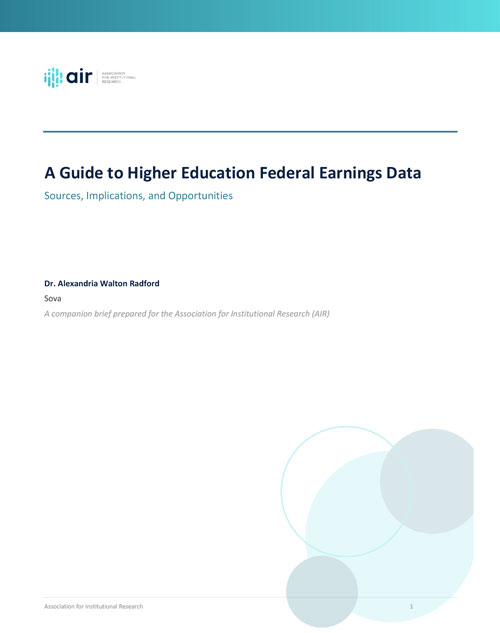
AIR Publishes Guide to Higher Education Federal Earnings Data
Federal earnings data are playing an increasingly important role in higher education — in federal accountability policy, consumer information, research, and institutional decision-making. The new Student Tuition an...Read Moreabout: AIR Publishes Guide to Higher Education Federal Earnings Data
About eAIR
Since 1987, eAIR has been the trusted newsletter for Institutional Researchers and data-informed leaders. Each issue brings you the latest perspectives, news, and practical resources to help you succeed in a changing higher education landscape.
Quick Links
Contribute
Articles
Have a perspective or best practice that could help colleagues? Contribute an article and add your voice to the national conversation.
News
Celebrate achievements, promotions, awards, and milestones. eAIR publishes professional news featuring community members.
Events
AIR welcomes brief conference/event announcements of interest to the IR and higher education communities.
Advertise
With thousands of readers across institutions, eAIR connects your brand with the decision-makers shaping the future of higher education.
Subscribe
Create a free account or update your communication preferences to receive the eAIR newsletter.