
Making Workforce Data Useful for Program Expansion
Using workforce data to decide whether to admit more students
A college is considering admitting more students to its technician program. The dean asks whether local hiring needs justify the increase.
Consider a hypothetical example. An employer plans to hire 120 people. Regional data show 10,000 existing jobs in the occupation. Nearby colleges awarded 80 related credentials last year.
Subtracting 80 credentials from 120 planned hires leaves 40. Does that justify adding 40 seats?
Figure 1. What the workforce figures measure
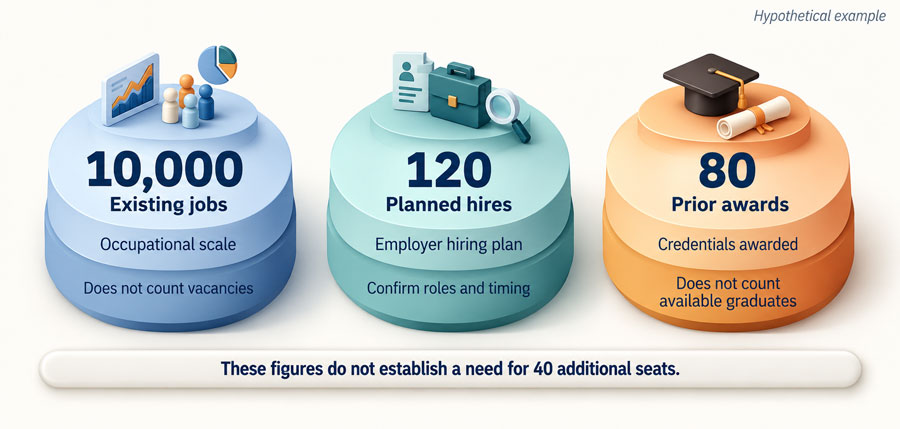
Illustrative values. Definitions draw on the Bureau of Labor Statistics (BLS) Occupational Employment and Wage Statistics (OEWS) program and the Integrated Postsecondary Education Data System (IPEDS) Completions survey (National Center for Education Statistics [NCES], n.d.-b; U.S. Bureau of Labor Statistics, n.d.).
This hypothetical example shows what is at stake. Adding seats commits teaching time, equipment, and students’ time. Before recommending expansion, an institutional researcher needs to establish what the numbers mean and how they connect.
Employment estimates describe existing jobs. Recruiting scenarios depend on assumptions. Completions describe educational output. In my workforce research, connecting these measures requires a closer look at employer needs and student pathways.
IR can help colleges assess workforce needs and student opportunity before increasing enrollment. The following checks support that discussion.
1. Confirm the Roles Before Planning Seats
Start with occupations, not industry labels. Healthcare includes clinical, administrative, and technical work with different preparation needs. Which of the 120 planned hires are technician roles? How many require experience? What must new graduates demonstrate on day one, and what will the employer teach?
Generative AI makes task-level review more urgent. The International Labour Organization’s (2025) task-based research identifies job transformation as the most likely overall effect. Anthropic’s September 2026 scenario model distinguishes tasks that AI assists, automates, or leaves unchanged; its futures are conditional scenarios (Anthropic, 2026). Ask employers which tasks are changing and faculty whether students need practice using AI, checking its outputs, or handling exceptions.
Suppose the employer clarifies that only 30 of the 120 positions are suitable for new graduates. That changes the college’s question immediately. Even those 30 roles do not establish a need for 30 additional seats. Current students and other pathways may already contribute, and the employer has not necessarily committed to hiring this college’s graduates.
IR can document the hiring scope and the evidence behind it. Faculty can assess preparation. The employer needs to confirm the roles.
2. Use Employment Estimates to Establish Scale
The BLS OEWS program estimates employment and wages by occupation. It does not count occupational vacancies or unemployed workers, and it excludes self-employment (BLS, n.d.).
Our hypothetical 10,000-job estimate provides context about occupational scale. It cannot establish how many people will apply for this employer’s roles.
Start with explicit scenarios for recruiting reach, hiring dates, and training completion. Monte Carlo simulation repeatedly samples uncertain inputs from specified probability distributions (Joint Committee for Guides in Metrology, 2008). It can show how assumptions affect a recommendation when the model, distributions, and dependencies are defensible. It cannot turn employment into available applicants or validate an employer’s plan. Here, simple scenarios are more credible than invented probabilities. Check compensation, shifts, commuting, and competing employers.
IR’s contribution is to keep the source, reference period, geography, and assumptions attached to the number when it reaches a decision slide.
3. Distinguish Credentials From Available Graduates
IPEDS distinguishes postsecondary awards earned (completions) from students completing programs (completers; NCES, n.d.-b). A count of awards is not automatically a count of unique graduates, much less available applicants.
In our example, some credential recipients may already be working, continue studying, pursue another occupation, or seek opportunities elsewhere. Assess these possibilities using available data and follow-up research.
IR can review student records to identify relevant completers without double-counting stacked credentials. Career services can check graduate destinations and current student groups. Workforce partners can identify apprenticeships and neighboring providers, then confirm program start dates, entry requirements, and capacity. A listed pathway does not establish an available seat. These checks help determine whether existing provision can meet the need.
4. Align Preparation With Hiring Timelines
Align the calendars before adding seats. Suppose the 30 entry-level openings occur before newly admitted students could finish. Expanding the program may support later opportunities, but it cannot deliver graduates for that immediate hiring window.
Figure 2. Match Completion Dates to Hiring Needs
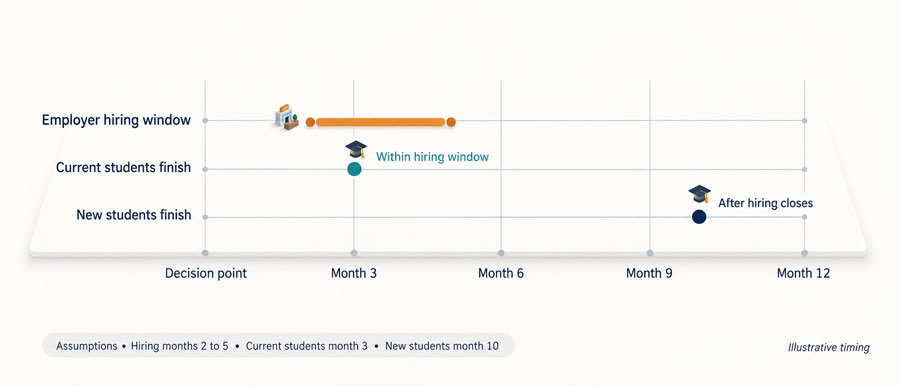
Illustrative dates. Timing alone does not establish job readiness or placement.
Ask whether current students, a targeted skills module, or employer-supported training could address the nearer-term need. Review the college’s capacity to provide the instruction and support each option requires.
The crosswalk between the Classification of Instructional Programs (CIP) and the Standard Occupational Classification (SOC) connects instructional programs and occupations based on the skills and knowledge associated with them (NCES, n.d.-a). It helps identify pathways to examine; it does not demonstrate that a particular curriculum satisfies an employer’s requirements.
Faculty and employers should review tasks, equipment, and work-based learning, including skills shared across adjacent occupations. Similar job titles do not establish interchangeable preparation. Check whether students can reach the worksite and accept the schedules.
5. Build the Evidence for Expansion
RReturn to the dean’s original question. The calculation “120 minus 80” has not established a 40-seat requirement. It combines planned hires and prior awards without aligning roles, people, preparation, or timing.
A recommendation to add seats becomes more defensible when the team identifies suitable opportunities, assesses existing pathways, and explains student benefit. Consider compatible needs across several employers alongside graduate outcomes, while checking each employer’s requirements and timing. Shared training may be useful without assuming a common hiring commitment.
The response may be additional seats for students. It may also be curriculum revision, training for incumbent workers, stronger placement partnerships, or further validation before committing resources.
Figure 3. Choose How the College Should Respond
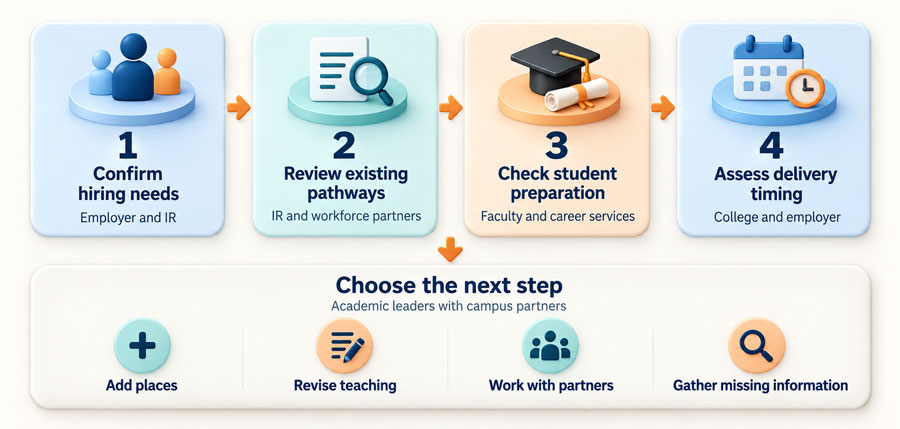
Author-created planning guide informed by BLS (n.d.) and NCES (n.d.-a, n.d.-b).
Five Checks for the Next Program Discussion
- Employer need: Which roles, skills, and hiring dates are confirmed and which remain assumptions?
- Existing pathways: What can current students and programs contribute without double-counting people or credentials?
- Student opportunity: Can graduates meet the requirements, reach the worksite, and pursue the available schedules?
- Delivery capacity: Can the college provide the instruction, equipment, and support in time?
- Decision evidence: What supports expansion and what would cause the team to reconsider?
Before adding seats, establish which opportunities the students could pursue, when those opportunities would be available, and what supports that expectation.
References
Anthropic. (2026). Scenarios for our economic future [Interactive scenario explorer].
 Sushma Vadlamannati is the founder of zScale Intellect, where she is building a Regional Evaluation System that connects business growth, workforce capacity, education pipelines, regional assets, and funding opportunities to help economic development teams and workforce boards evaluate regional opportunities and coordinate workforce responses. Her background spans enterprise data systems, investing, and advising founders. She publishes the biweekly Workforce Intelligence Brief with practical examples and insights into how regions are addressing workforce challenges and creating pathways to economic prosperity.
Contact. sushma@zscaleintellect.com
LinkedIn. Sushma Vadlamannati