
2024 AIR National Survey: IR/IE Office Staff
This brief is one of a series of reports. Learn more at airweb.org/nationalsurvey.
Institutional Research and Effectiveness (IR/IE) offices play a critical role in advancing data-informed decision making across colleges and universities. Their staffing structures, both in scale and in the diversity of professional expertise, shape an institution’s capacity to use data effectively and strategically. Drawing on the 2024 AIR National Survey, this brief examines current staffing models, workloads, and resource needs. As expectations for analytics, planning, assessment, and compliance expand, these findings help illuminate how IR/IE offices contribute to institutional readiness and ongoing improvement.
Staff FTE
Chart 1 shows the average number of full-time equivalent (FTE) staff in IR/IE offices across major sectors. Public 4-year institutions have the largest offices, averaging 5.5 FTE. In contrast, both public 2-year and private not-for-profit 4-year institutions average 2.9 FTE. These findings reflect clear sector-based differences in institutional capacity and investment in IR/IE staffing.
Chart 1. Average Staff FTE

For IR/IE offices that participated in all three survey cycles (2018, 2021, and 2024), average staff FTE has declined from 4.0 in 2018 to 3.7 in 2024 (Table 1). This gradual decline in average staffing underscores the importance of sustained attention to institutional data capacity and the resources needed to support it.
| Year | Average Staff FTE |
|---|---|
| 2024 | 3.7 |
| 2021 | 3.8 |
| 2018 | 4.0 |
Survey findings indicate a strong correlation between IR/IE office staff FTE and student FTE enrollment (r = .60, p < .001). Chart 2 overlays average staff FTE with student FTE enrollment by sector. Public 4-year institutions serve significantly larger student populations (averaging 12,201 FTE) compared to public 2-year institutions (4,157) and private not-for-profit 4-year institutions (4,058). Their IR/IE staff sizes scale accordingly, but not proportionally: public 4-year institutions have nearly triple the student enrollment but only about double the staff FTE. This pattern highlights persistent capacity gaps, even among institutions with comparatively greater resources.
Chart 2. Relationship between IR/IE Office Staff FTE and Student FTE Enrollment*
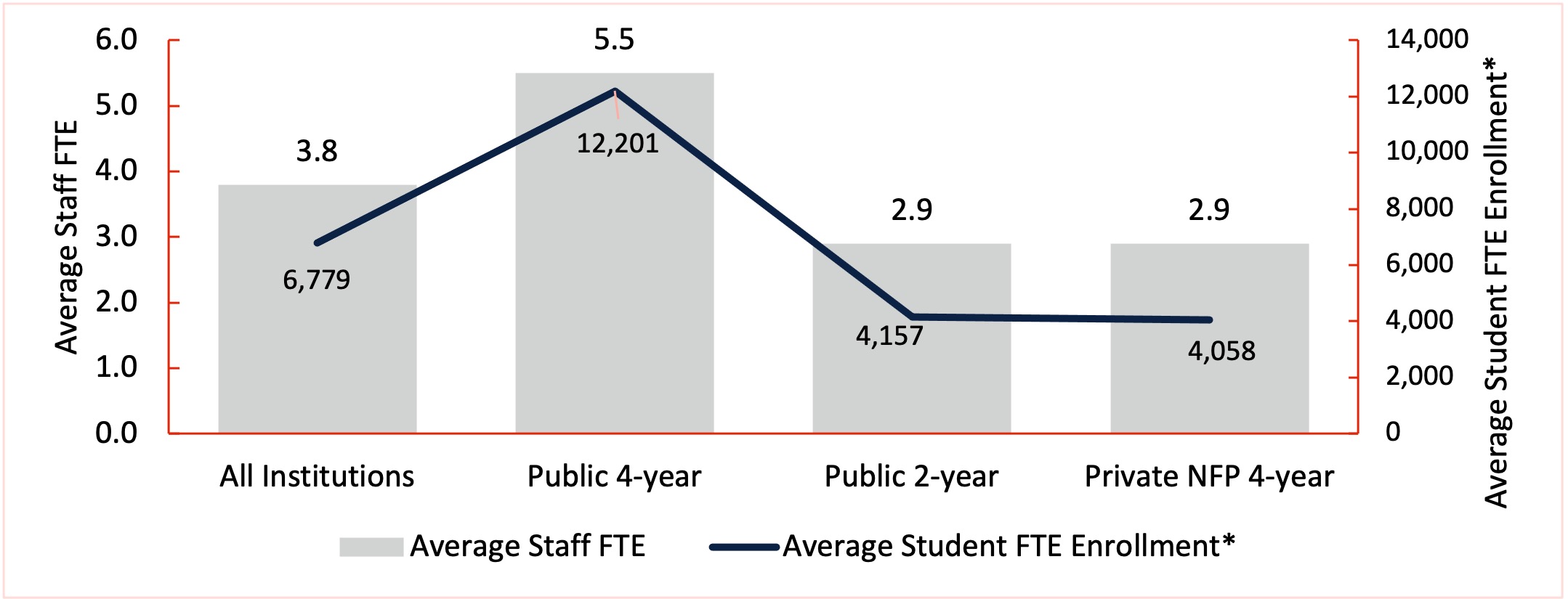
*Enrollment data reported from the 2023 Integrated Postsecondary Education Data System (IPEDS), 12-month enrollment survey, sum of undergraduate (FTEUG), graduate (FTEGD), and doctor’s-professional practice (FTEDPP).
Staffing levels increase consistently with enrollment (Table 2). Institutions with fewer than 3,000 students report an average of 2.1 FTE, while those with 20,000+ students average 10.1 FTE. This trend confirms the expected relationship between institutional size and IR/IE capacity while also illustrating substantial variation in what different institutions can sustain. Sector-based differences are also evident: public 4-year institutions consistently report higher staffing levels across every enrollment range.
| Enrollment | All Institutions | Public 4-year | Public 2-year | Private NFP 4-year |
|---|---|---|---|---|
| Less than 3,000 student FTE | 2.1 | 2.8 | 2.3 | 1.9 |
| 3,000 to 4,999 student FTE | 2.9 | 3.3 | 3.0 | 2.7 |
| 5,000 to 9,999 student FTE | 4.4 | 4.4 | 4.0 | 5.1 |
| 10,000 to 19,999 student FTE | 6.5 | 6.4 | 5.2 | 7.1 |
| 20,000 or more student FTE | 10.1 | 10.5 | 4.5 | 10.4 |
Chart 3 shows that 31% of IR/IE offices operate with one or fewer staff FTE, while only 13% have more than 6 FTE. This distribution indicates that many offices continue to function with limited staffing capacity, even as expectations for data and analytics work expand.
Chart 3. Distribution of IR/IE Offices by Staff FTE
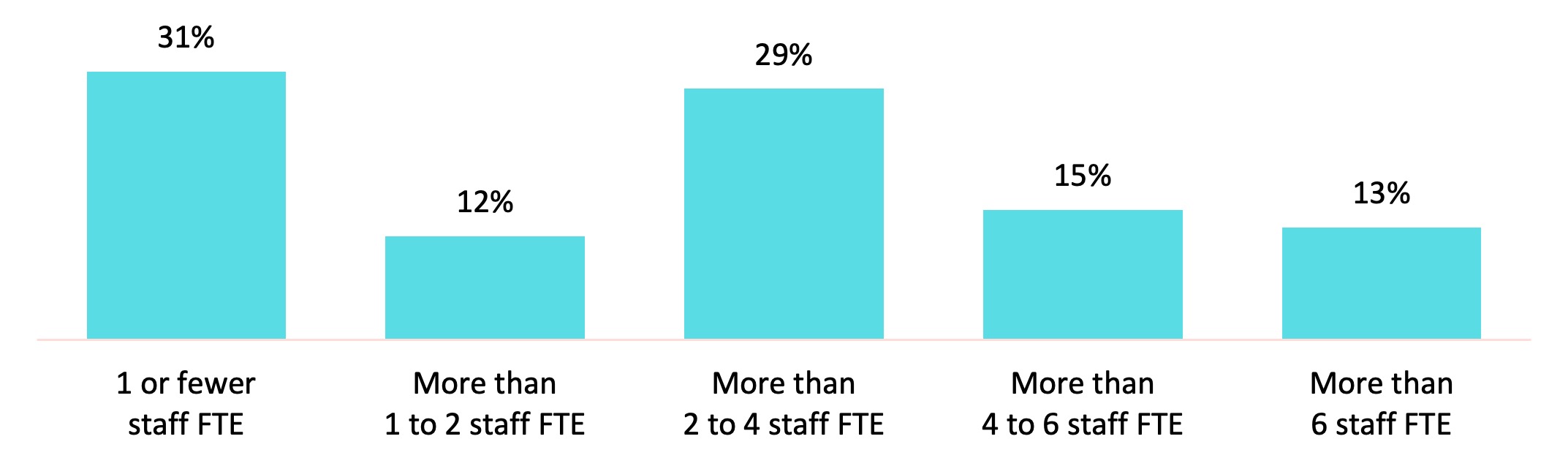
Table 3 provides a more detailed view of these differences by enrollment size and sector. Offices with fewer than 3,000 student FTE are most likely to be small (41% have one or fewer staff) while nearly half (45%) of institutions with 20,000+ students report more than 6 FTE. Among sectors, public 2-year institutions show the most even staffing distribution, and public 4-year institutions have a higher concentration of mid-sized offices (2–4 FTE).
| Institution Type | 1 or fewer staff FTE | > 1 to 2 FTE | > 2 to 4 staff FTE | > 4 to 6 staff FTE | > 6 staff FTE |
|---|---|---|---|---|---|
| All Institutions | 31% | 12% | 29% | 15% | 13% |
| Student FTE Enrollment* | |||||
| Less than 3,000 student FTE | 41% | 14% | 27% | 7% | 10% |
| 3,000 to 4,999 student FTE | 48% | 17% | 27% | 6% | 3% |
| 5,000 to 9,999 student FTE | 27% | 18% | 35% | 16% | 4% |
| 10,000 to 19,999 student FTE | 7% | 5% | 49% | 27% | 12% |
| 20,000 or more student FTE | 9% | 4% | 15% | 26% | 45% |
| Sector | |||||
| Public 4-year | 31% | 12% | 29% | 14% | 13% |
| Public 2-year | 13% | 9% | 32% | 22% | 23% |
| Private NFP 4-year | 34% | 13% | 29% | 18% | 6% |
*Enrollment data reported from the 2023 Integrated Postsecondary Education Data System (IPEDS), 12-month enrollment survey, sum of undergraduate (FTEUG), graduate (FTEGD), and doctor’s-professional practice (FTEDPP).
Staff Roles
All IR/IE offices include a designated leader, but only some have additional professional roles such as associate or assistant directors, senior analysts, or technical staff (Table 4). These expanded staffing structures are more common at public 4-year institutions, where 62% report having senior analysts, compared to just 25% of private not-for-profit 4-year institutions. This suggests that public 4-year institutions are more likely to support tiered staffing models within their IR/IE offices.
| Role | All Institutions | Public 4-year | Public 2-year | Private NFP 4-year |
|---|---|---|---|---|
| Office Leader | 100% | 100% | 100% | 100% |
| Senior Associate Directors | 9% | 13% | 4% | 8% |
| Associate Directors | 13% | 19% | 3% | 14% |
| Assistant Directors | 13% | 19% | 7% | 12% |
| Senior Analysts | 40% | 62% | 36% | 25% |
| Junior Analysts | 36% | 48% | 36% | 27% |
| Senior Assessment Professionals | 6% | 7% | 6% | 6% |
| Junior Assessment Professionals | 5% | 7% | 6% | 4% |
| Technical Support Staff | 16% | 26% | 10% | 12% |
| Administrative Support Staff | 19% | 26% | 23% | 12% |
| Graduate Student Staff | 10% | 19% | 0% | 8% |
| Undergraduate Student Staff | 10% | 13% | 4% | 11% |
Table 5 summarizes the composition of office teams. Senior analysts (2.0 FTE) and junior analysts (1.7 FTE) comprise the core of most teams, with technical staff (1.5 FTE) also playing a significant role. Graduate and undergraduate student staff contribute less than 1 FTE on average each, while office leaders are consistently represented at a full FTE across all sectors.
| Role | All Institutions | Public 4-year | Public 2-year | Private NFP 4-year |
|---|---|---|---|---|
| Office Leader | 1.0 | 1.0 | 1.0 | 1.0 |
| Senior Associate Director | 1.5 | 1.6 | 1.0 | 1.6 |
| Associate Director | 1.4 | 1.3 | 1.7 | 1.5 |
| Assistant Director | 1.2 | 1.4 | 1.1 | 1.1 |
| Senior Analysts | 2.0 | 2.2 | 1.9 | 1.7 |
| Junior Analysts | 1.7 | 2.0 | 1.4 | 1.6 |
| Senior Assessment Staff | 1.3 | 1.4 | 0.9 | 1.3 |
| Junior Assessment Staff | 1.2 | 1.3 | 1.0 | 1.1 |
| Technical Staff | 1.5 | 1.8 | 1.0 | 1.2 |
| Administrative Support Staff | 0.9 | 1.0 | 0.7 | 0.8 |
| Graduate Student Staff | 0.8 | 0.9 | NA | 0.6 |
| Undergraduate Student Staff | 0.7 | 0.7 | 0.7 | 0.8 |
| Average Staff FTE per Office | 3.8 | 5.5 | 2.9 | 2.9 |
Creating sufficient capacity within the IR/IE office can be challenging, leading some institutions to engage faculty associates to expand their analytical capabilities. According to the survey, 5% of IR/IE offices report working with faculty associates, with an average headcount of 1.6 contributing approximately 8.8 hours per week (Table 6). While public 2-year institutions are only slightly more likely to use this model (6%), those that do appear to rely on it more heavily, reporting an average of 2.7 faculty associates who contribute 15.7 hours per week, nearly double the engagement seen in other sectors.
| Faculty | All Institutions | Public 4-year | Public 2-year | Private NFP 4-year |
|---|---|---|---|---|
| Percentage of IR/IE Offices with Faculty Associates | 5% | 4% | 6% | 4% |
| Average headcount of Faculty Associates | 1.6 | 1.1 | 2.7 | 1.1 |
| Average number of hours/week a Faculty Associate contributes to IR/IE Office | 8.8 | 5.3 | 15.7 | 6.8 |
Another approach to expanding institutional data capacity involves strengthening analytics functions outside the IR/IE office. Nearly half of institutions (49%) report having distributed or embedded analysts within administrative units (Table 7). In most cases (69%), these analysts maintain a collaborative relationship with the IR/IE office, though only 2% report directly to it. Most institutions (75%) have between 1 and 5 FTE in these roles, indicating a modest but supportive presence.
| Analyst Details | All Institutions | Public 4-year | Public 2-year | Private NFP 4-year |
| Percentage of institutions with distributed analysts | 49% | 52% | 25% | 59% |
| Relationship Between Analysts and IR/IE Office | ||||
| Only a collaborative relationship between analyst and IR/IE Office. | 69% | 70% | 72% | 68% |
| Relationship depends on the unit. | 16% | 18% | 14% | 16% |
| No relationship | 6% | 3% | 7% | 8% |
| Analysts report to unit with a dotted-line relationship with IR/IE Office | 5% | 7% | 0% | 6% |
| Analysts have a direct-report relationship with IR/IE Office | 2% | 2% | 7% | 1% |
| Other | 1% | 0% | 0% | 1% |
| Staff FTE of Distributed Analysts | ||||
| 1 FTE or less | 23% | 13% | 33% | 27% |
| 2 to 5 FTE | 52% | 50% | 58% | 52% |
| 6 to 10 FTE | 14% | 22% | 4% | 10% |
| 11 or more FTE | 11% | 15% | 4% | 10% |
Distributed analysts are less common in academic units; 24% of institutions report having these positions. When present, these analysts tend to collaborate with IR/IE but are far less common, especially in public 2-year institutions (7%). Staffing levels in these roles mirror those in administrative units (Table 8).
| Analyst Details | All Institutions | Public 4-year | Public 2-year | Private NFP 4-year | |
| Percentage of institutions with distributed analysts | 24% | 34% | 7% | 26% | |
| Relationship Between Analysts and IR/IE Office | |||||
| Only a collaborative relationship between analyst and IR/IE Office. | 69% | 73% | 75% | 65% | |
| Relationship depends on the unit. | 15% | 18% | 13% | 12% | |
| No relationship | 9% | 5% | 0% | 13% | |
| Analysts have a direct-report relationship with IR/IE Office | 3% | 4% | 13% | 2% | |
| Analysts report to unit with a dotted-line relationship with IR/IE Office | 2% | 0% | 0% | 5% | |
| Other | 2% | 0% | 0% | 3% | |
| Staff FTE of Distributed Analysts | |||||
| 1 FTE or less | 26% | 23% | 50% | 25% | |
| 2 to 5 FTE | 49% | 43% | 50% | 54% | |
| 6 to 10 FTE | 15% | 23% | 0% | 10% | |
| 11 or more FTE | 10% | 11% | 0% | 10% | |
Together, these staffing models illustrate an emphasis on collaboration and distributed capacity as institutions seek to expand analytic reach and responsiveness.
Evaluation of Staff FTE
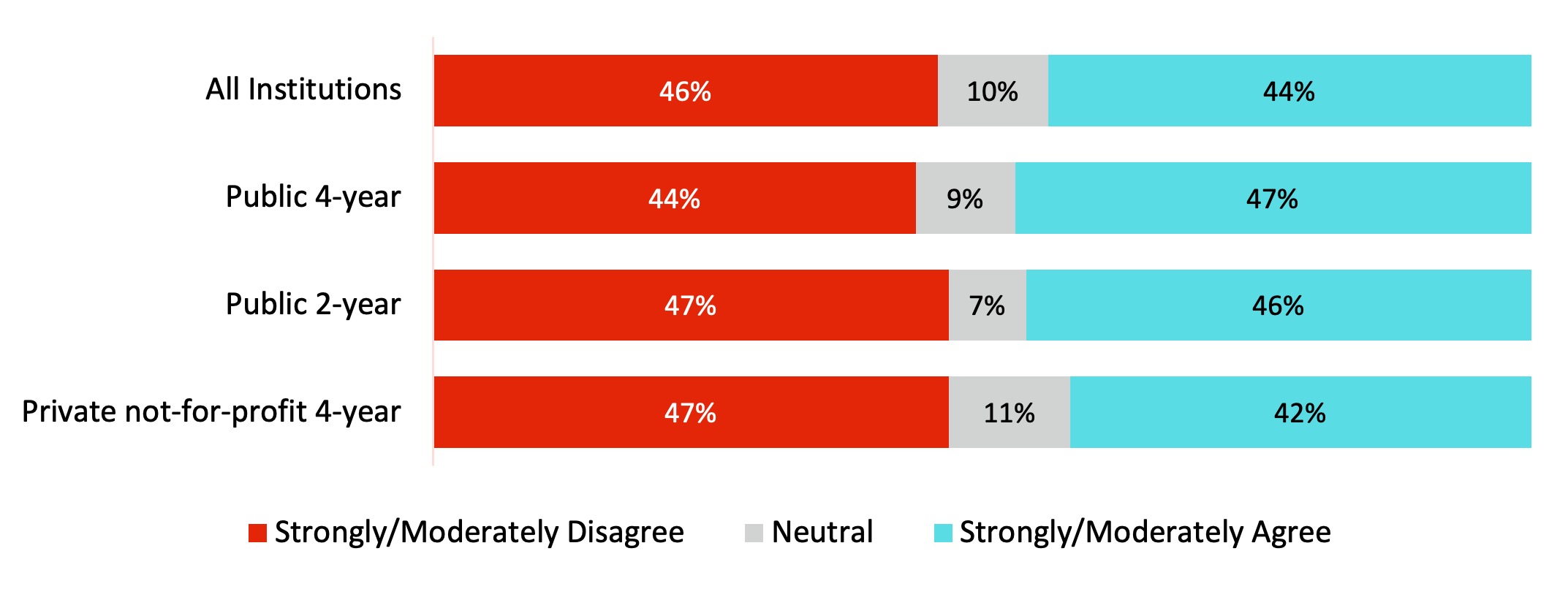
We asked office leaders to indicate their level of agreement with the statement, “At our current staffing level, the office can achieve its goals by never or rarely asking staff to work overtime.” Only 44% of IR/IE leaders agreed, suggesting that regular overtime is common for many offices (Chart 4). Agreement levels were consistent across sectors pointing to widespread pressure on staffing capacity.
Chart 4. Office Can Achieve Work Without Staff Working Overtime
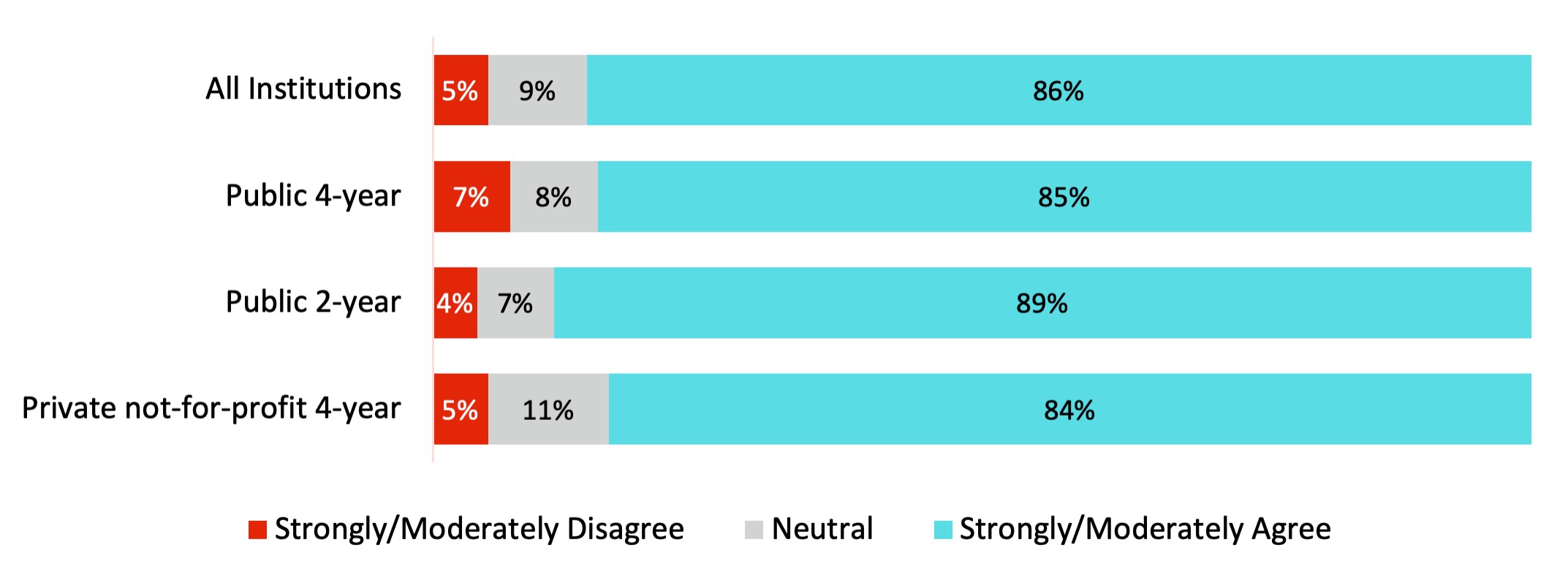
Regardless of overtime concerns, nearly all office leaders (86%) agreed their offices could better meet institutional expectations with additional staff. This sentiment is consistent across sectors, reflecting a shared recognition that current staffing levels limit the ability of IR/IE offices to fully support institutional priorities. (Chart 5).
Chart 5. Office Can Better Meet Institutional Expectations with Additional Staff
When asked about staffing needed to meet current and future expectations, office leaders reported an ideal average of 5.5 FTE, rising to 6.0 FTE over the next three years. Compared to the current average of 3.8 FTE, this suggests that most IR/IE offices would benefit from roughly two additional full-time positions to align capacity with current institutional needs (Chart 6).
Chart 6. Comparison of Current Staff FTE vs. Ideal Staff FTE

Table 9 details the projected staffing gaps by enrollment and sector: larger institutions (20,000+ student FTE) report the most substantial needs, projecting the ideal growth from 10.1 to 15.9 FTE. Public 4-year institutions report the largest gaps (from 5.5 to 8.4 FTE over 3 years), while private not-for-profit 4-year institutions and public 2-year institutions anticipate smaller, but still meaningful gaps.
| Institution Details | Actual Staff FTE | Ideal Staff FTE | Ideal Staff FTE - 3 Years from Now |
|---|---|---|---|
| All Institutions | 3.8 | 5.5 | 6.0 |
| Student FTE Enrollment | |||
| Less than 3,000 student FTE | 2.1 | 3.2 | 3.7 |
| 3,000 to 4,999 student FTE | 2.9 | 3.9 | 4.5 |
| 5,000 to 9,999 student FTE | 4.4 | 6.4 | 6.3 |
| 10,000 to 19,999 student FTE | 6.5 | 9.7 | 10.6 |
| 20,000 or more student FTE | 10.1 | 14.4 | 15.9 |
| Sector | |||
| Public 4-year | 5.5 | 7.6 | 8.4 |
| Public 2-year | 2.9 | 4.6 | 4.6 |
| Private NFP 4-year | 2.9 | 4.3 | 4.8 |
*Enrollment data reported from the 2023 Integrated Postsecondary Education Data System (IPEDS), 12-month enrollment survey, sum of undergraduate (FTEUG), graduate (FTEGD), and doctor’s-professional practice (FTEDPP).
Taken together, these findings illustrate both the diversity and the limitations of current IR/IE staffing models. As institutions look to strengthen their analytic capacity, attention to both office structure and the professionals who comprise these teams will be essential.
Staff Characteristics
In addition to examining staff roles and FTE, the survey explored the demographic characteristics of IR/IE office staff. Table 10 presents the gender identity breakdown by institutional sector (excluding the office leader). Overall, IR/IE staff are predominantly women (60%), with men representing 39%.
| Gender Identity | All Institutions | Public 4-year | Public 2-year | Private NFP 4-year |
|---|---|---|---|---|
| Identify as women | 60% | 57% | 61% | 64% |
| Identify as men | 39% | 42% | 38% | 35% |
| Identify as another gender | 1% | 0% | 0% | 1% |
The racial and ethnic composition of IR/IE staff (excluding the office leader) is majority White (65%), followed by Asian (16%) and Black or Hispanic staff (13% combined); see Table 11.
| Race/Ethnicity | All Institutions | Public 4-year | Public 2-year | Private NFP 4-year |
|---|---|---|---|---|
| White | 65% | 60% | 67% | 72% |
| Asian | 16% | 17% | 13% | 16% |
| Hispanic or Latino/a | 7% | 8% | 9% | 6% |
| Black or African American | 6% | 7% | 8% | 3% |
| Bi/Multiracial | 3% | 4% | 2% | 2% |
| Middle Eastern or North African | 2% | 2% | 1% | 1% |
| American Indian or Alaska Native | 1% | 2% | 0% | 1% |
| Native Hawaiian or Pacific Islander | 0% | 0% | 0% | 0% |
IR/IE staff are also highly educated: 70% hold graduate degrees, including 18% with doctorates (Table 12). This high level of educational attainment is consistent across sectors and reflects the advanced analytical, technical, and communication skills required for success in this field.
| Degree | All Institutions | Public 4-year | Public 2-year | Private NFP 4-year |
|---|---|---|---|---|
| Baccalaureate degree or lower | 30% | 31% | 31% | 27% |
| Master’s degree/Specialist | 52% | 50% | 57% | 52% |
| Doctoral degree, including professional practice doctorates | 18% | 19% | 13% | 20% |
Working Conditions
Office leaders were asked to estimate the average number of hours worked per week by staff role. Office leaders report the longest work weeks (44 hours), followed by senior associate directors (42) and analysts (40). Technical staff and junior analysts also report relatively high average hours, while student workers and admin staff report fewer hours (Chart 7).
Chart 7. Average Hours Worked Per Week by Staff Role

One in four office leaders (25%) work more than 50 hours per week, with this proportion rising to 34% at public 4-year institutions (Table 13). While less common, some senior analysts and associate directors also report working more than 50 hours, reflecting the sustained demand for institutional data and analytic support.
| Staff | All Institutions | Public 4-year | Public 2-year | Private NFP 4-year |
| Office Leader | 25% | 34% | 20% | 20% |
| Senior Associate Director | 9% | 5% | 0% | 16% |
| Associate Director | 11% | 15% | 33% | 6% |
| Assistant Director | 1% | 3% | 0% | 0% |
| Senior Analysts | 5% | 6% | 2% | 4% |
| Junior Analysts | 2% | 3% | 3% | 0% |
| Senior Assessment Staff | 0% | 0% | 0% | 0% |
| Junior Assessment Staff | 0% | 0% | 0% | 0% |
| Technical Staff | 4% | 4% | 0% | 4% |
| Administrative Support Staff | 1% | 2% | 0% | 0% |
| Graduate Student Staff | 2% | 3% | N/A | 0% |
| Undergraduate Student Staff | 0% | 0% | 0% | 0% |
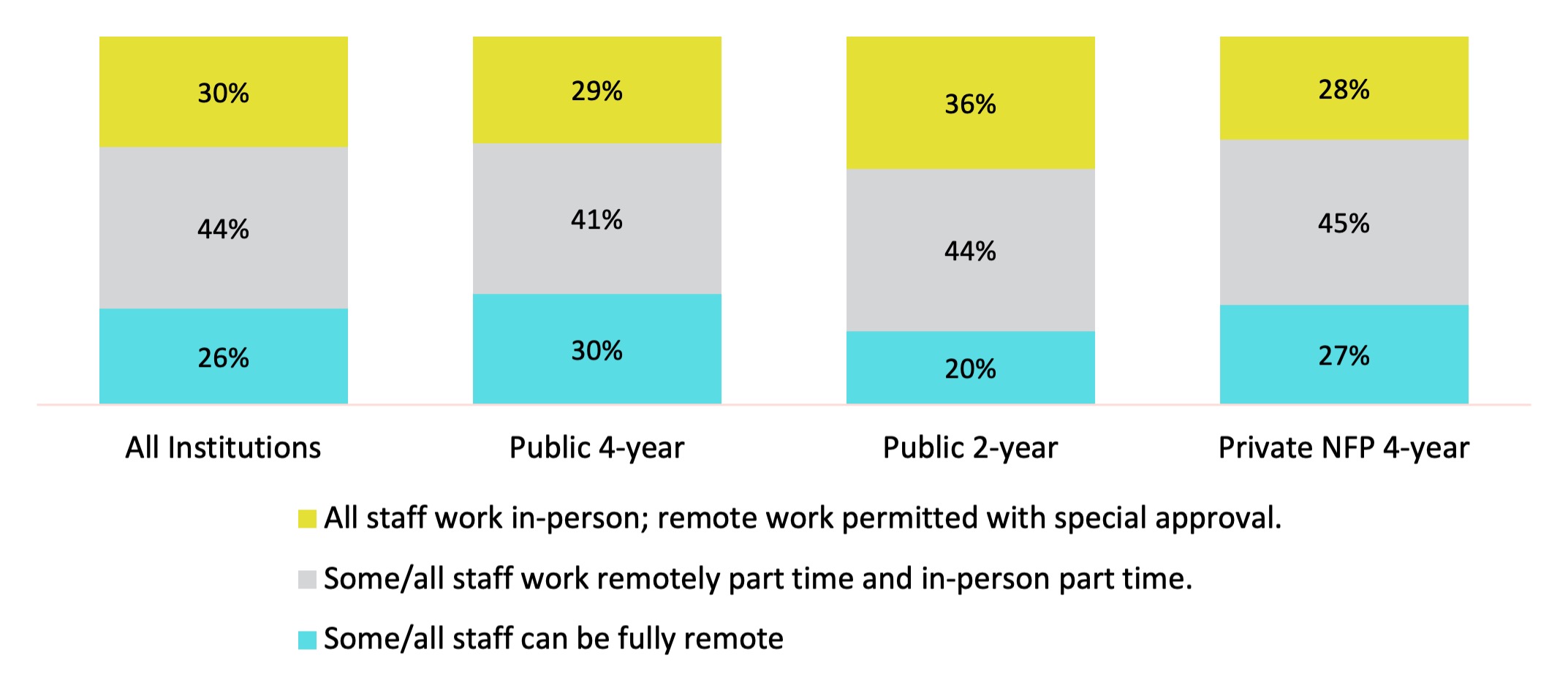
Flexible work arrangements are increasingly common. 26% of IR/IE offices allow some or all staff to work fully remotely, and another 44% offer hybrid schedules (Chart 8). These flexible models are slightly more prevalent at public and private not-for-profit 4-year institutions, suggesting a continued shift toward adaptable work environments post-COVID.
Chart 8. Work Options
Summary
The 2024 AIR National Survey highlights both the strength and the strain within IR/IE offices across U.S. higher education. While most offices are staffed by highly educated and dedicated professionals, the data reveal persistent gaps between current staffing levels and institutional needs, particularly at smaller and resource-constrained institutions. One-third of offices have just one or fewer FTE, and most identify a need for at least two additional staff to meet current and future demands. Despite these challenges, IR/IE professionals remain central to advancing data-informed decision making, collaborating across units, and contributing to key institutional priorities. Sustained investment in staffing capacity through expanded roles, distributed analysts, and supportive working conditions will be essential to maintain and strengthen this critical work.
Methodology
The 2024 AIR National Survey targeted leaders of Institutional Research and Effectiveness (IR/IE) offices at 1,676 U.S. postsecondary, degree-granting institutions across all sectors, control types, and sizes. A total of 633 institutions submitted responses. To ensure comparability and data quality, this report excludes incomplete responses as well as those from for-profit institutions, administrative units, international institutions, private not-for-profit 2-year institutions, and institutions located in U.S. territories due to low response rates in these categories.
The findings presented in this report are based on 552 complete or semi-complete responses from U.S. degree-granting institutions, including:
- 183 public 4-year institutions
- 118 public 2-year institutions
- 251 private not-for-profit 4-year institutions
Where possible, longitudinal comparisons are included. These comparisons draw on data from:
- 253 institutions that responded to both the 2024 and 2021 AIR National Surveys
- 147 institutions that responded to the 2024, 2021, and 2018 AIR National Surveys
Suggested Citation
Jones, D. and Keller, C. (2024). 2024 AIR National Survey: IR/IE Office Work [Report]. Association for Institutional Research. www.airweb.org/NationalSurvey.
Long Description
Chart 1. Average Staff FTE
Numerical values presented on the image:
| Institution Type | Average Staff FTE |
|---|---|
| All Institutions | 3.8 |
| Public 4-year | 5.5 |
| Public 2-year | 2.9 |
| Private NFP 4-year | 2.9 |
Chart 2. Relationship between IR/IE Office Staff FTE and Student FTE Enrollment*
Numerical values presented on the image:
| Sector | Average Staff FTE | Average Student FTE Enrollment* |
|---|---|---|
| All Institutions | 3.8 | 6,779 |
| Public 4-year | 5.5 | 12,201 |
| Public 2-year | 2.9 | 4,157 |
| Private NFP 4-year | 2.9 | 4,058 |
Chart 3. Distribution of IR/IE Offices by Staff FTE
Numerical values presented on the image:
| FTE | All Institutions |
|---|---|
| 1 or fewer staff FTE | 31% |
| More than 1 to 2 staff FTE | 12% |
| More than 2 to 4 staff FTE | 29% |
| More than 4 to 6 staff FTE | 15% |
| More than 6 staff FTE | 13% |
Chart 4. Office Can Achieve Work Without Staff Working Overtime
Numerical values presented on the image:
| Office Can Achieve Work Without Staff Working Overtime | Private not-for-profit 4-year | Public 2-year | Public 4-year | All Institutions |
|---|---|---|---|---|
| Strongly/Moderately Disagree | 47% | 47% | 44% | 46% |
| Neutral | 11% | 7% | 9% | 10% |
| Strongly/Moderately Agree | 42% | 46% | 47% | 44% |
Chart 5. Office Can Better Meet Institutional Expectations with Additional Staff
Numerical values presented on the image:
| Can Better Meet Institutional Expectations with Additional Staff | Private not-for-profit 4-year | Public 2-year | Public 4-year | All Institutions |
|---|---|---|---|---|
| Strongly/Moderately Disagree | 5% | 4% | 7% | 5% |
| Neutral | 11% | 7% | 8% | 9% |
| Strongly/Moderately Agree | 84% | 89% | 85% | 86% |
Chart 6. Comparison of Current Staff FTE vs. Ideal Staff FTE
Numerical values presented on the image:
| Current Staff FTE | Ideal Staff FTE | Ideal Staff FTE - 3 Years from Now |
|---|---|---|
| 3.8 | 5.5 | 6.0 |
| Difference | 1.7 | 2.2 |
Chart 7. Average Hours Worked Per Week by Staff Role
Numerical values presented on the image:
| Staff Role | All Institutions |
|---|---|
| Office Leader | 44 |
| Senior Associate Director | 42 |
| Associate Director | 41 |
| Senior Analysts | 40 |
| Assistant Director | 40 |
| Senior Assessment Staff | 39 |
| Junior Analysts | 39 |
| Technical Staff | 37 |
| Junior Assessment Staff | 36 |
| Administrative Support Staff | 33 |
| Graduate Student Staff | 18 |
| Undergraduate Student Staff | 14 |
Chart 8. Remote Work Options
Numerical values presented on the image:
| Remote Work Options | All Institutions | Public 4-year | Public 2-year | Private NFP 4-year |
|---|---|---|---|---|
| Some/all staff can be fully remote | 26% | 30% | 20% | 27% |
| Some/all staff work remotely part time and in-person part time. | 44% | 41% | 44% | 45% |
| All staff work in-person; remote work permitted with special approval. | 30% | 29% | 36% | 28% |