
2024 AIR National Survey: IR/IE Office Staff Salaries
This brief is one of a series of reports. Learn more at airweb.org/nationalsurvey.
Transforming data into informed decisions requires not only technological infrastructure but also sustained investment in people, their knowledge, and skills, and capacity to manage and use data effectively. Institutional Research and Institutional Effectiveness (IR/IE) offices depend on professionals who bring analytical, technical, and strategic expertise, along with the communication and judgment needed to apply those skills in institutional contexts, making salary a key factor in recruitment, retention, and long-term capacity. The 2024 AIR National Survey examined salary levels for IR/IE roles, alongside institutional context, regional variation, and trends over time. This report analyzes salary data from over 500 U.S. institutions to help colleges and universities better understand the labor market for IR/IE professionals.
Annual Staff Salaries
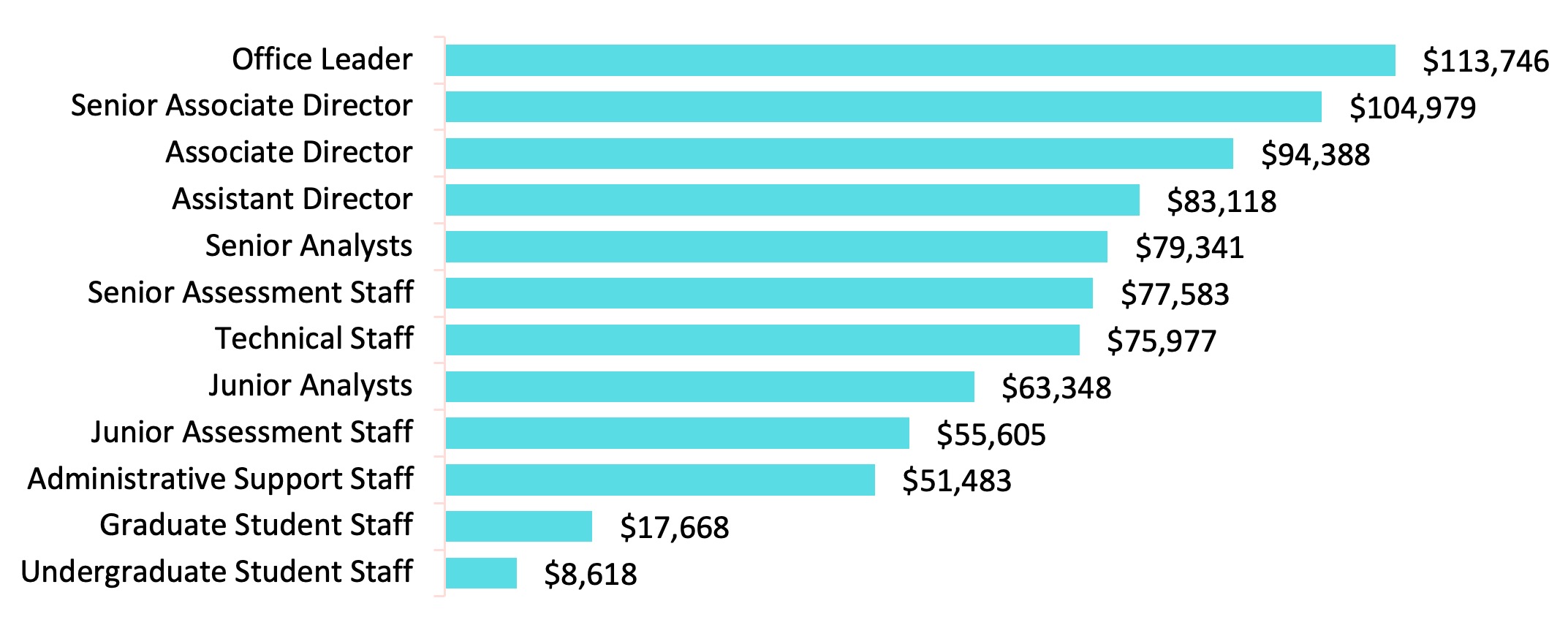
IR/IE salaries differ markedly by role, reflecting differences in responsibility, experience, and seniority. Office leaders earn the highest average salaries, nearly $114,000, a pattern consistent with standard organizational hierarchies (Chart 1).
Chart 1. Average Salary of IR/IE Office Staff
Sector-level differences are also notable. Public 4-year institutions pay the highest salaries for nearly every role (Table 1). Private not-for-profit institutions show more variation, with some roles earning relatively more than their public institution counterparts (e.g., junior assessment staff).
| Staff Role | All Institutions | Public 4-year | Public 2-year | Private NFP 4-year |
|---|---|---|---|---|
| Office Leader | $113,746 | $132,587 | $103,310 | $104,764 |
| Senior Associate Director | $104,979 | $111,979 | $96,000 | $101,099 |
| Associate Director | $94,388 | $99,628 | $75,077 | $91,429 |
| Assistant Director | $83,118 | $88,437 | $78,675 | $77,495 |
| Senior Analysts | $79,341 | $80,158 | $81,534 | $76,637 |
| Junior Analysts | $63,348 | $63,093 | $62,569 | $64,204 |
| Senior Assessment Staff | $77,583 | $82,635 | $70,590 | $76,069 |
| Junior Assessment Staff | $55,605 | $54,444 | $46,400 | $62,664 |
| Technical Staff | $75,977 | $79,369 | $61,482 | $75,669 |
| Administrative Support Staff | $51,483 | $54,329 | $48,584 | $48,693 |
| Graduate Student Staff | $17,668 | $20,692 | NA | $8,596 |
| Undergraduate Student Staff | $8,618 | $10,107 | $10,000 | $6,213 |
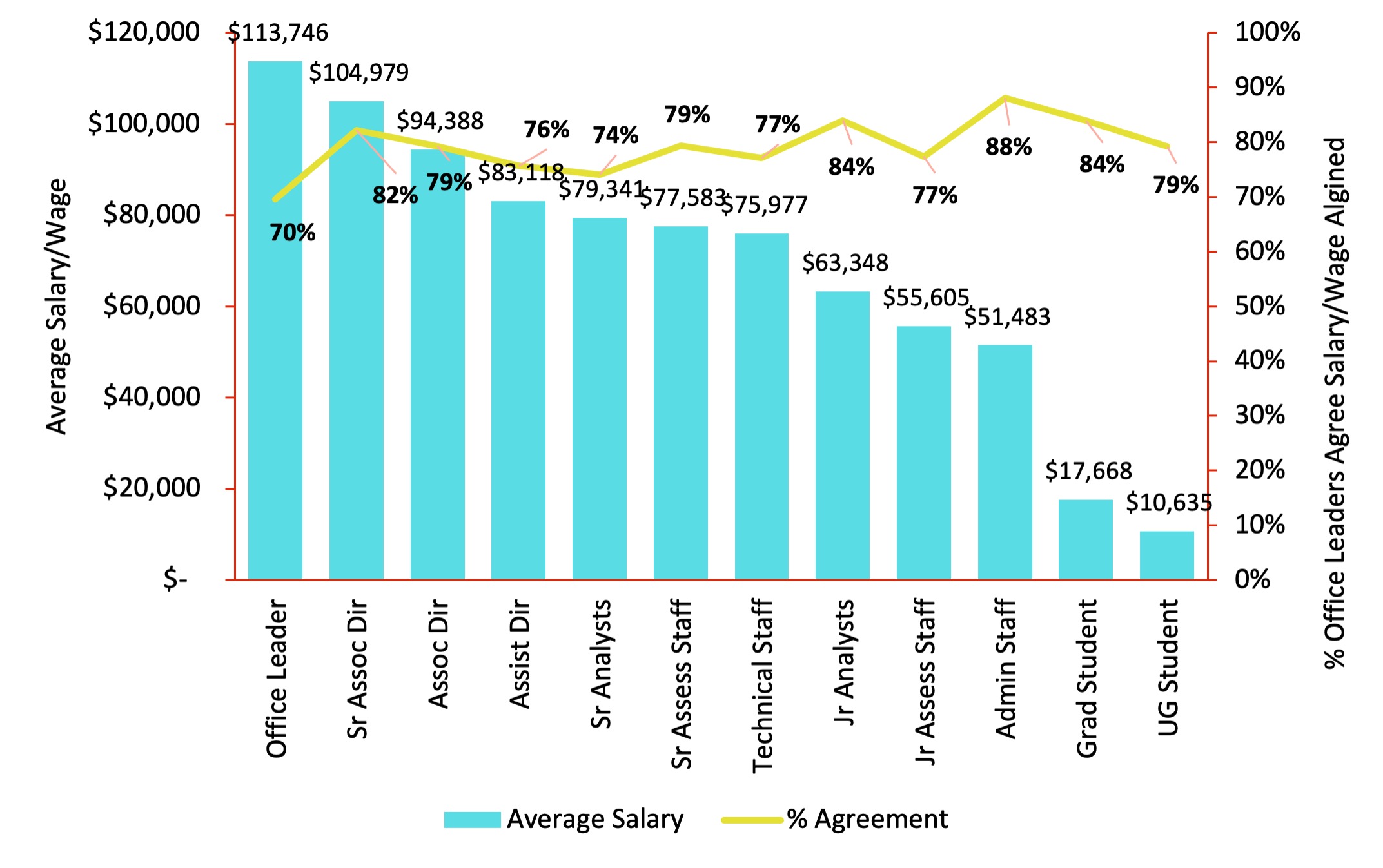
A new 2024 survey question asked office leaders whether salaries for each role reflected staff qualifications and workload. The results were largely positive: at least 70% of leaders agreed that salaries were appropriate across all roles (Chart 2). Agreement was highest for administrative support staff (88%), junior analysts (84%), and graduate assistants (84%), indicating broad satisfaction with entry- and mid-level pay. Views were somewhat more mixed for the office leader role, though 70% of respondents affirmed that their own salary was appropriate.
Chart 2. Comparing Average Salary to % of Office Leaders who Responded that Salary/Wage is Aligned with Experience, Education, Work Effort
While most leaders view salaries as appropriate across roles, institutional characteristics, particularly size, also play a clear role in shaping salary patterns.
Salaries by Enrollment
Survey results show a strong positive correlation between office leader salaries and institutional size (r = .635, p < .001). Public 4-year institutions, with an average enrollment of over 12,000 students, offer the highest salaries. In contrast, public 2-year and private not-for-profit 4-year institutions, which enroll fewer students on average, report lower average pay (Chart 3). This pattern mirrors findings from the 2024 AIR National Survey report titled IR/IE Office Staff which showed that larger institutions tend to employ more staff.
Chart 3. Relationship between IR/IE Office Leader Salary
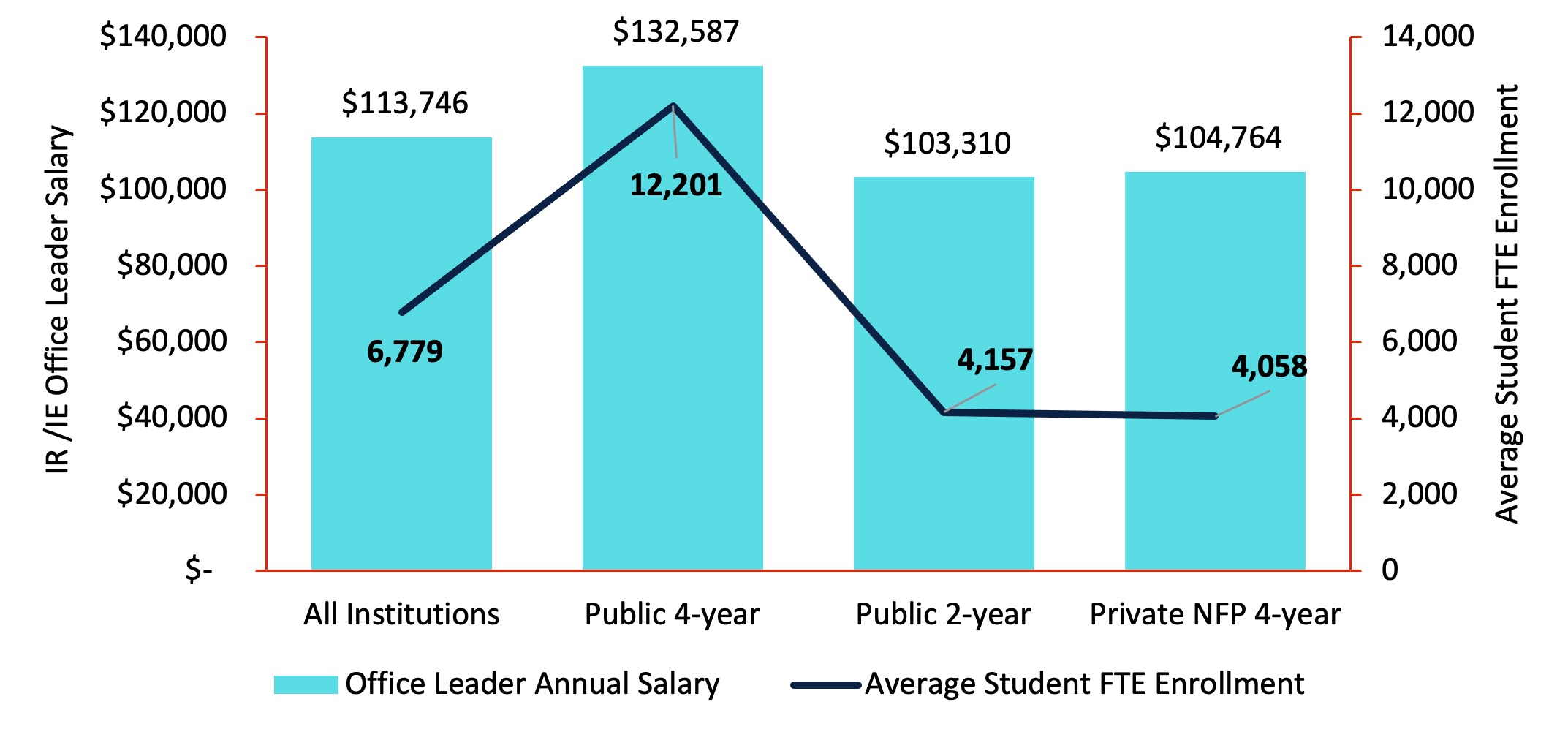
*Enrollment data reported from the 2023 Integrated Postsecondary Education Data System (IPEDS), 12-month enrollment survey, sum of undergraduate (FTEUG), graduate (FTEGD), and doctor’s-professional practice (FTEDPP).
A more detailed breakdown confirms the relationship: institutions with fewer than 3,000 FTE students report average office leader salaries of $95,174, compared with $161,199 at institutions enrolling 10,000 or more student FTE (Table 2).
| Enrollment | All Institutions | Public 4-year | Public 2-year | Private NFP 4-year |
|---|---|---|---|---|
| Less than 3,000 student FTE | 95,174 | 102,672 | 91,030 | 94,792 |
| 3,000 to 4,999 student FTE | 105,961 | 99,534 | 114,000 | 104,441 |
| 5,000 to 9,999 student FTE | 125,239 | 124,644 | 119,621 | 133,707 |
| 10,000+ student FTE | 161,199 | 163,886 | 123,947 | 167,231 |
*Enrollment data reported from the 2023 Integrated Postsecondary Education Data System (IPEDS), 12-month enrollment survey, sum of undergraduate (FTEUG), graduate (FTEGD), and doctor’s-professional practice (FTEDPP). Values in U.S. Dollars.
Salary patterns also vary geographically, reflecting regional labor markets and cost-of-living differences.
Salaries by U.S. Census Region
Geographic location continues to play a notable role in salary. Salaries are highest in the Northeast and West and lowest in the South and Midwest (Table 3). Similar patterns emerge across other roles, including analysts, assessment staff, and technical positions. Regional cost of living likely influences these patterns, but the differences remain important for institutions seeking to remain competitive in recruitment.
| Role | All Institutions | Northeast (n = 126) | West (n = 102) | South (n = 161) | Midwest (n = 163) |
|---|---|---|---|---|---|
| Office Leader | 113,746 | 123,672 | 119,841 | 117,443 | 100,481 |
| Senior Associate Director | 104,979 | 114,321 | 78,044 | 111,275 | 100,336 |
| Associate Director | 94,388 | 94,843 | 105,889 | 92,074 | 87,600 |
| Assistant Director | 83,118 | 82,889 | 77,408 | 85,144 | 83,948 |
| Senior Analysts | 79,341 | 84,714 | 84,811 | 75,876 | 74,641 |
| Senior Assessment Staff | 77,583 | 81,203 | 107,500 | 71,503 | 72,915 |
| Technical Staff | 75,977 | 87,396 | 69,885 | 75,295 | 72,188 |
| Junior Analysts | 63,348 | 66,913 | 67,408 | 62,661 | 57,797 |
| Junior Assessment Staff | 55,605 | 49,386 | 56,500 | 62,400 | 47,500 |
| Administrative Support Staff | 51,483 | 51,794 | 52,624 | 52,190 | 48,731 |
| Graduate Student Staff | 17,668 | 4,805 | 28,587 | 14,550 | 18,554 |
| Undergraduate Student Staff | 8,618 | 7,000 | 12,000 | 8,664 | 9,000 |
*U.S. Census Bureau regions https://www2.census.gov/geo/pdfs/maps-data/maps/reference/us_regdiv.pdf; Values in U.S. Dollars.
Longitudinal Salary Changes: 2021 to 2024
Among IR/IE offices that responded in both 2021 and 2024 and provided salary data, salaries increased across all roles with office leaders experiencing the largest absolute gain (Chart 4).
Chart 4. Longitudinal Changes in Staff Salaries: 2021 and 2024
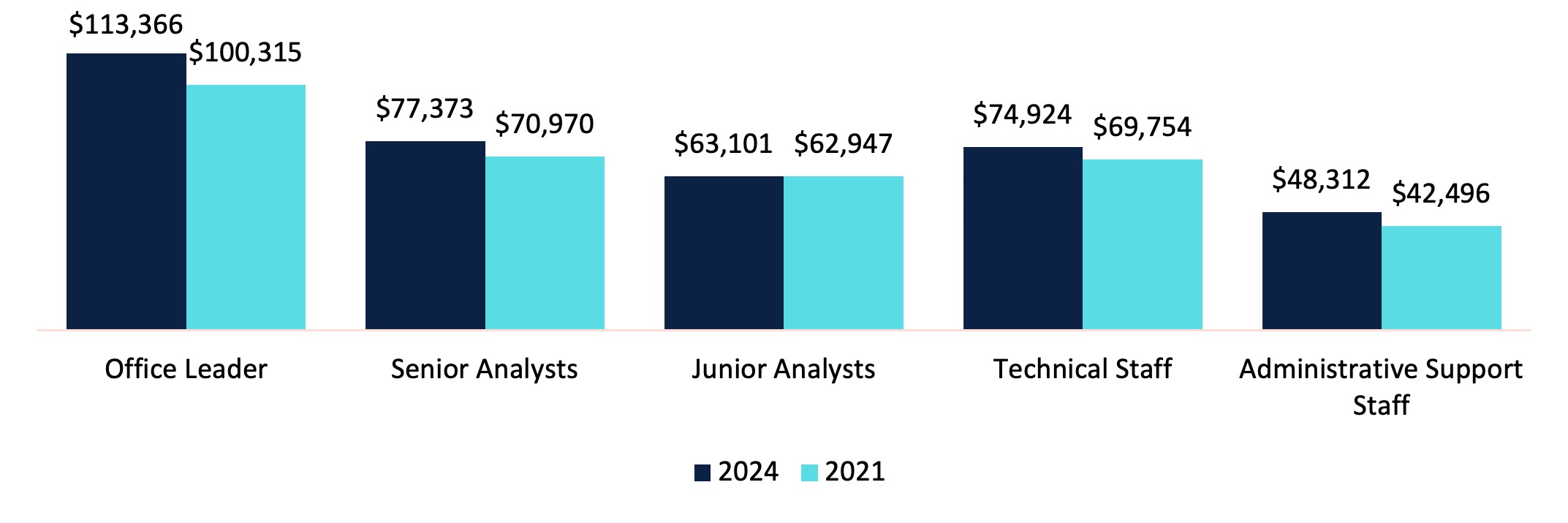
Note: Chart only shows roles common to the 2021 and 2024 surveys.
Table 4 presents salary differences by sector. Public 2-year office leaders saw the largest increase among the sectors, with salaries rising nearly $18,000. This growth narrowed the salary gap between public 2-year leaders and their 4-year counterparts, reflecting a potential shift toward more equitable compensation across sectors.
| Role | All Institutions | Public 4-year | Public 2-year | Private NFP 4-year | ||||
|---|---|---|---|---|---|---|---|---|
| 2024 | 2021 | 2024 | 2021 | 2024 | 2021 | 2024 | 2021 | |
| Office Leader | 113,366 | 100,315 | 132,587 | 119,794 | 103,310 | 85,336 | 104,764 | 93,303 |
| Senior Analysts | 77,373 | 70,970 | 80,158 | 73,161 | 81,534 | 74,158 | 76,637 | 65,773 |
| Junior Analysts | 63,101 | 62,947 | 63,093 | 71,421 | 62,569 | 57,264 | 64,204 | 54,489 |
| Technical Staff | 74,924 | 69,754 | 79,369 | 73,066 | 61,482 | 65,333 | 75,669 | 65,450 |
| Administrative Support Staff | 48,312 | 42,496 | 54,329 | 42,621 | 48,584 | 40,746 | 48,693 | 44,122 |
Note: Table only shows roles common to the 2021 and 2024 surveys. Values in U.S. dollars.
Between early 2021 and late 2024, the Consumer Price Index (CPI) rose by approximately 18%. Using the U.S. Bureau of Labor Statistics CPI Inflation Calculator, we can estimate the salary growth needed across IR/IE roles to maintain purchasing power. For all roles, salary growth lagged behind inflation, indicating a decline in real earnings for much of the IR/IE workforce over this period (Table 5).
| Role | Average 2024 Salary | Projected 2024 Salary* | Difference |
|---|---|---|---|
| Office Leader | 113,366 | 118,276 | -4,910 |
| Senior Analysts | 77,373 | 83,677 | -6,304 |
| Junior Analysts | 63,101 | 74,217 | -11,116 |
| Technical Staff | 74,924 | 82,243 | -7,319 |
| Administrative Support Staff | 48,312 | 50,105 | -1,794 |
*Reference: U.S. Bureau of Labor Statistics, CPI Inflation Calculator, https://www.bls.gov/data/inflation_calculator.htm
Longitudinal Salary Changes: 2018 to 2024
Among IR/IE offices that responded in 2018, 2021, and 2024 and provided salary data, sustained salary growth was observed across all roles (Chart 5). Office leader salaries increased by nearly $23,000 between 2018 and 2024, while pay for technical staff and administrative support also rose steadily.
Chart 5. Longitudinal Changes in Staff Salaries: 2018, 2021, and 2024
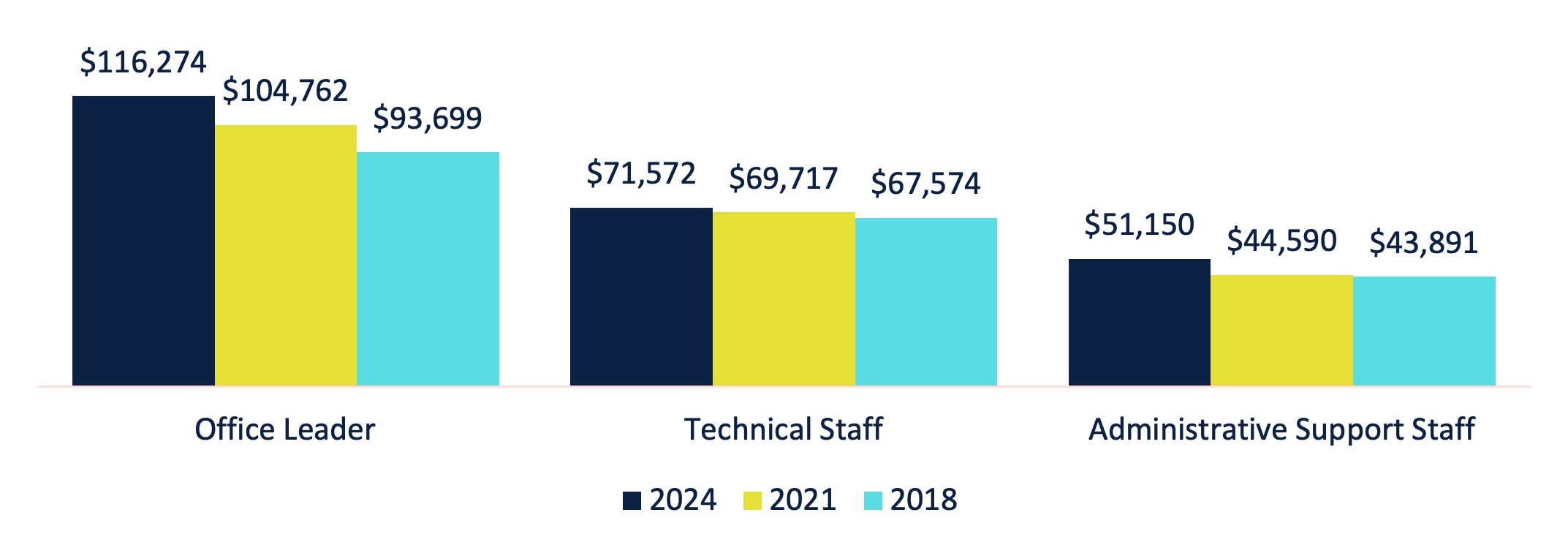
Note: Chart only shows roles common to the 2018, 2021, and 2024 surveys.
A more detailed view reveals that office leader salaries increased by approximately $20,000 across all sectors from 2018 to 2024 (Table 6).
| Role | All Institutions | Public 4-year | Public 2-year | Private NFP 4-year | ||||||||
|---|---|---|---|---|---|---|---|---|---|---|---|---|
| 2024 | 2021 | 2018 | 2024 | 2021 | 2018 | 2024 | 2021 | 2018 | 2024 | 2021 | 2018 | |
| Office Leader | 116,274 | 104,762 | 93,699 | 132,827 | 127,376 | 112,509 | 103,576 | 91,059 | 83,716 | 105,671 | 91,097 | 85,119 |
| Technical Staff | 71,572 | 69,717 | 67,574 | 70,038 | 78,510 | 68,939 | N/A | 61,500 | 60,105 | 74,420 | 51,900 | 67,713 |
| Admin Support Staff | 51,150 | 44,590 | 43,891 | 52,793 | 45,586 | 44,716 | 45,779 | 43,040 | 44,780 | 50,250 | 42,994 | 54,199 |
Note: Table only shows roles common to the 2018, 2021, and 2024 surveys. Values in U.S. dollars.
Table 7 compares actual 2024 salaries with inflation-adjusted salary projections, based on a 25% increase in the Consumer Price Index (CPI) between 2018 and 2024. Across all three roles, average salaries fell short of inflation-adjusted expectations. Office leaders came closest to keeping pace while technical staff experienced the largest gap. Overall, the findings suggest that while nominal salaries have increased since 2018, real earnings have not kept pace with inflation, particularly technical and support positions.
| Role | Actual 2024 Salary | Projected 2024 Salary* | Difference |
|---|---|---|---|
| Office Leader | 116,274 | 116,588 | -314 |
| Technical Staff | 71,572 | 84,081 | -12,509 |
| Administrative Support Staff | 51,150 | 54,613 | -3,463 |
*Reference: U.S. Bureau of Labor Statistics, CPI Inflation Calculator, https://www.bls.gov/data/inflation_calculator.htm
Summary
The 2024 AIR National Survey reveals steady salary growth across most IR/IE roles, with the highest pay levels concentrated at larger institutions and in higher-cost regions, particularly the Northeast and West. Leadership roles have experienced the greatest absolute gains. However, when adjusted for inflation, especially over the longer term from 2018 to 2024, the picture is more sobering: real earnings have not kept pace with rising costs.
Even so, IR/IE leaders express broad satisfaction with how salaries align with education, experience, and workload especially for mid-level and entry-level positions. As institutional demand for data governance, planning, assessment, and analytics continues to expand, maintaining competitive salaries will be crucial to recruiting and retaining highly skilled professionals. Sustained investment in salary structures, particularly technical and analytical roles, will help ensure that IR/IE offices can meet institutional priorities and advance a culture of data-informed decision making.
Methodology
The 2024 AIR National Survey targeted leaders of Institutional Research and Effectiveness (IR/IE) offices at 1,676 U.S. postsecondary, degree-granting institutions across all sectors, control types, and sizes. A total of 633 institutions submitted responses. To ensure comparability and data quality, this report excludes incomplete responses as well as those from for-profit institutions, administrative units, international institutions, private not-for-profit 2-year institutions, and institutions located in U.S. territories due to low response rates in these categories.
The findings presented in this report are based on 552 complete or semi-complete responses from U.S. degree-granting institutions, including:
- 183 public 4-year institutions
- 118 public 2-year institutions
- 251 private not-for-profit 4-year institutions
Where possible, longitudinal comparisons are included. These comparisons draw on data from:
- 253 institutions that responded to both the 2024 and 2021 AIR National Surveys
- 147 institutions that responded to the 2024, 2021, and 2018 AIR National Surveys
Suggested Citation
Jones, D. & Keller, C. (2024). 2024 AIR National Survey of IR Offices: Staff Salaries [Report]. Association for Institutional Research.www.airweb.org/NationalSurvey.
Long Description
Chart 1. Average Salary of IR/IE Office Staff
Numerical values presented on the image:
| Role | All Institutions |
|---|---|
| Office Leader | $113,746 |
| Senior Associate Director | $104,979 |
| Associate Director | $94,388 |
| Assistant Director | $83,118 |
| Senior Analysts | $79,341 |
| Junior Analysts | $63,348 |
| Senior Assessment Staff | $77,583 |
| Junior Assessment Staff | $55,605 |
| Technical Staff | $75,977 |
| Administrative Support Staff | $51,483 |
| Graduate Student Staff | $17,668 |
| Undergraduate Student Staff | $8,618 |
Chart 2. Comparing Average Salary to % of Office Leaders who Responded that Salary/Wage is Aligned with Experience, Education, Work Effort
Numerical values presented on the image:
| Role | Average Salary | % Agreement |
|---|---|---|
| Office Leader | $113,746 | 70% |
| Sr Assoc Dir | $104,979 | 82% |
| Assoc Dir | $ 94,388 | 79% |
| Assist Dir | $83,118 | 76% |
| Sr Analysts | $79,341 | 74% |
| Sr Assess Staff | $77,583 | 79% |
| Technical Staff | $75,977 | 77% |
| Jr Analysts | $63,348 | 84% |
| Jr Assess Staff | $55,605 | 77% |
| Admin Staff | $51,483 | 88% |
| Grad Student | $17,668 | 84% |
| UG Student | $10,635 | 79% |
Chart 3. Relationship between IR/IE Office Leader Salary and Student FTE Enrollment
Numerical values presented on the image:
| Institution Type | All Institutions | Public 4-year | Public 2-year | Private NFP 4-year |
|---|---|---|---|---|
| Average Student FTE Enrollment | 6,779 | 12,201 | 4,157 | 4,058 |
| Office Leader Annual Salary | $113,746 | $132,587 | $103,310 | $104,764 |
Chart 4. Longitudinal Changes in Staff Salaries: 2021 and 2024
Numerical values presented on the image:
| Role | 2024 | 2021 |
|---|---|---|
| Office Leader | 113,366 | 100,315 |
| Senior Analysts | 77,373 | 70,970 |
| Junior Analysts | 63,101 | 62,947 |
| Technical Staff | 74,924 | 69,754 |
| Administrative Support Staff | 48,312 | 42,496 |
Chart 5. Longitudinal Changes in Staff Salaries: 2018, 2021, and 2024
Numerical values presented on the image:
| Role | 2024 | 2021 | 2018 |
|---|---|---|---|
| Office Leader | $116,274 | $104,762 | $93,699 |
| Technical Staff | $71,572 | $69,717 | $67,574 |
| Administrative Support Staff | $51,150 | $44,590 | $43,891 |