
2024 AIR National Survey: IR/IE Office Organizational Structure
This brief is one of a series of reports. Learn more at airweb.org/nationalsurvey.
Organizational structure influences how information flows, decisions are made, and authority is exercised within institutions. For Institutional Research and Effectiveness (IR/IE) offices, reporting lines and team configurations offer reveal priorities, leadership relationships, and the evolving and expanding role of data in decision making. The 2024 AIR National Survey examined how IR/IE offices are structured, to whom they report, and how those relationships have changed over time. The results highlight not only the current reporting patterns but also institutional preferences and the broader strategic positioning of IR/IE functions across sectors and enrollment sizes.
Structure of the IR/IE Data Function
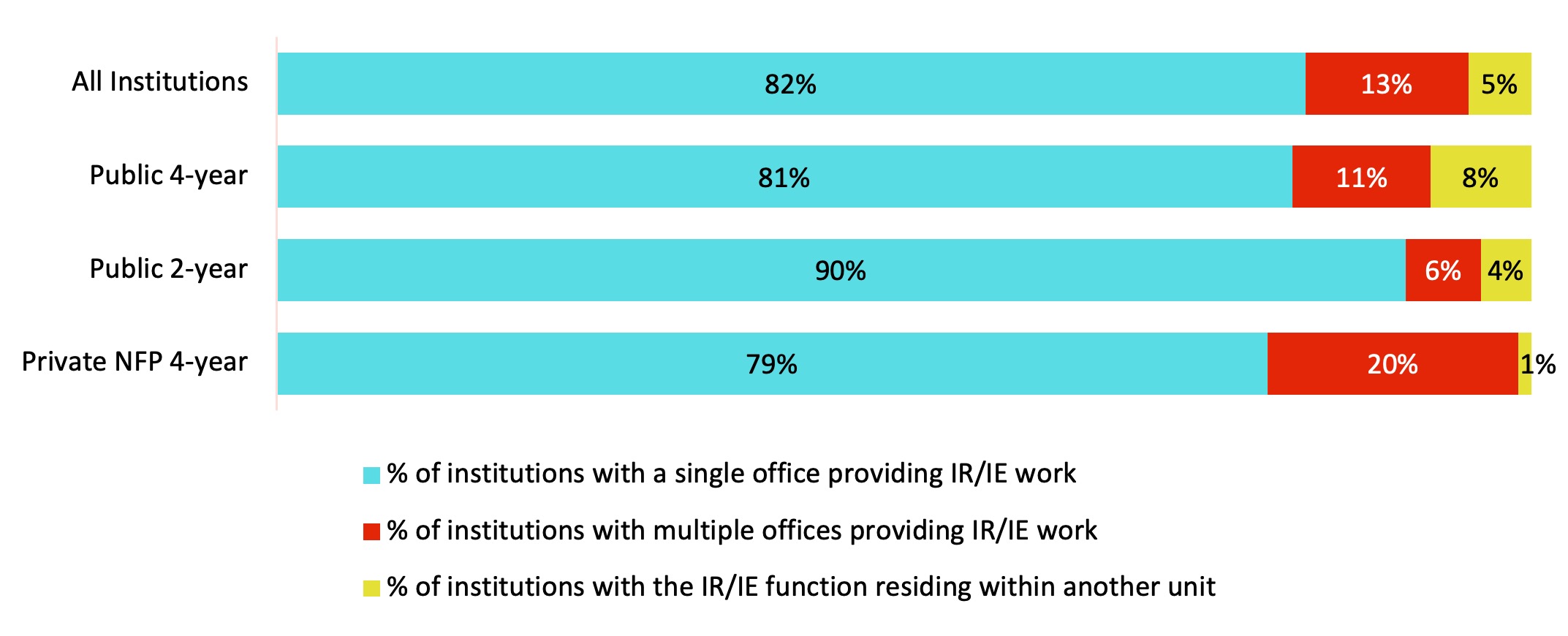
The 2024 AIR National Survey included new questions about how the IR/IE function is structured within institutions. Most respondents (82%) reported having a single IR/IE office, while 13% indicated multiple offices responsible for institutional research and effectiveness functions (Chart 1). A smaller proportion (5%) noted that their IR/IE function is embedded within another unit, such as information technology (IT).
Chart 1. Structure of the IR/IE Data Function
Institutional size, measured by student FTE, strongly influences how the IR/IE function is structured (Table 1). At smaller institutions (fewer than 3,000 student FTE), 10% house the IR/IE function within another unit, such as Enrollment Management or IT, far more common than in any other enrollment category. As institutions grow into the mid-sized to large range (3,000 to 19,999 student FTE), a more consistent pattern emerges: approximately 85% of institutions maintain a single IR/IE office, while about 15% operate with multiple offices responsible for IR/IE work.
However, among very large institutions (20,000 or more student FTE), the structure changes significantly. In this group, only 62% continue with a single IR/IE office, while 38% report having multiple offices, a substantial increase that likely reflects the complexity and scale of analytics demands across very large institutions. These findings suggest that while centralized IR/IE models dominate across most institutions, larger institutions increasingly adopt multi-office models to meet broader and more diverse data needs.
| Structure | Less than 3,000 student FTE | 3,000 to 4,999 student FTE | 5,000 to 9,999 student FTE | 10,000 to 19,999 student FTE | 20,000 or more student FTE |
|---|---|---|---|---|---|
| % of institutions with a single office providing IR/IE work | 84% | 81% | 85% | 85% | 62% |
| % of institutions with multiple offices providing IR/IE work | 6% | 16% | 15% | 15% | 38% |
| % of institutions with the IR/IE function residing within another unit | 10% | 3% | 0% | 0% | 0% |
*Enrollment data reported from the 2023 Integrated Postsecondary Education Data System (IPEDS), 12-month enrollment survey, sum of undergraduate (FTEUG), graduate (FTEGD), and doctor’s-professional practice (FTEDPP). FTE = full-time equivalent.
Among institutions with a single IR/IE office, 87% operate as a single person or a single team led by one individual (Table 2). The remaining 13% are structured with multiple teams or sub-units, often under a senior leader. Public 4-year institutions are most likely to have the single-person model (90%), whereas 18% of private not-for-profit 4-years report a more complex internal structure.
| Structure | All Institutions | Public 4-year | Public 2-year | Private NFP 4-year |
|---|---|---|---|---|
| One person/team under the leadership of a single person (likely a director-level position or higher) | 87% | 90% | 88% | 82% |
| Multiple teams/units operating within that office (each team likely led by a director-led position or higher); Office led by an institutional senior leader | 13% | 10% | 12% | 18% |
Team structure also scales with institutional size. At small institutions (fewer than 3,000 student FTE), 94% of IR/IE offices are led by a single person (Table 3). But among very large institutions with 20,000 or more students, the proportion declines to 56%, with 44% operating multiple teams or units, reinforcing the relationship between institutional size and organizational complexity.
| Structure | Less than 3,000 student FTE | 3,000 to 4,999 student FTE | 5,000 to 9,999 student FTE | 10,000 to 19,999 student FTE | 20,000 or more student FTE |
|---|---|---|---|---|---|
| One person/team under the leadership of a single person (likely a director-level position or higher) | 94% | 88% | 83% | 76% | 56% |
| Multiple teams/units operating within that office (each team likely led by a director-led position or higher); Office led by an institutional senior leader | 6% | 12% | 17% | 24% | 44% |
*Enrollment data reported from the 2023 Integrated Postsecondary Education Data System (IPEDS), 12-month enrollment survey, sum of undergraduate (FTEUG), graduate (FTEGD), and doctor’s-professional practice (FTEDPP). FTE = full-time equivalent.
Current Reporting Relationships
Across all institutions, 55% of IR/IE leaders report to the Provost or Chief Academic Officer, 21% report directly to the President or CEO, and 7% report to a dedicated IR/IE or Strategic Planning unit (Chart 2). Reporting structures, however, vary notably by sector. In public 2-year institutions, 32% of IR/IE leaders report to the Provost, compared to 66% in private not-for-profit institutions, a difference that reflects distinct organizational alignments and leadership roles for IR/IE.
Chart 2. Top Three Current IR/IE Office Reporting Relationships by Sector
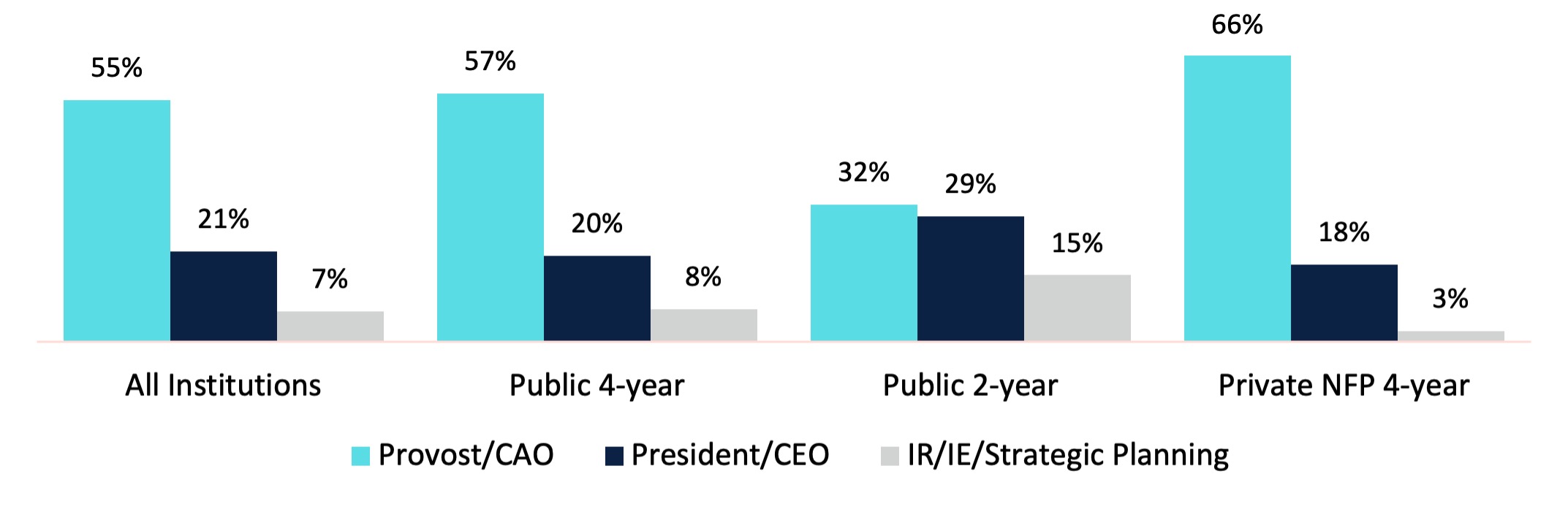
Beyond these primary reporting lines, smaller proportions of IR/IE offices report to Finance/Operations (6%), Information Technology (4%), and Enrollment Management (3%). Public 2-year institutions show the greatest variation, with 15% of offices reporting to an IR/IE/Strategic Planning division and 7% to IT (Table 4). These differences highlight how sector context and institutional culture shape the placement and role of IR/IE offices.
| Office | All Institutions | Public 4-year | Public 2-year | Private NFP 4-year |
|---|---|---|---|---|
| Provost/CAO | 55% | 57% | 32% | 66% |
| President/CEO | 21% | 20% | 29% | 18% |
| IR/IE/Strategic Planning | 7% | 8% | 15% | 3% |
| Finance/Operations/Business | 6% | 8% | 4% | 6% |
| Information Technology (IT) | 4% | 3% | 7% | 3% |
| Enrollment Management/Admissions | 3% | 3% | 2% | 2% |
| Institutional Advancement/ Development or similar office | 1% | 0% | 5% | 1% |
| Administration Services | 1% | 0% | 3% | 0% |
| Human Resources | 1% | 1% | 1% | 0% |
| Other | 1% | 0% | 2% | 1% |
| Student Life/Student Affairs | 0% | 0% | 1% | 0% |
| Communications and Marketing | 0% | 0% | 1% | 0% |
Longitudinal Changes in Reporting Relationships
Among those institutions that participated in both the 2021 and 2024 surveys, the percentage of IR/IE offices reporting to the President increased by four percentage points, while offices reporting to the Provost and IT decreased slightly (Table 5). These shifts may reflect a gradual move to align IR/IE functions more directly with executive leadership.
| Role | 2024 | 2021 |
|---|---|---|
| Provost/CAO | 58% | 60% |
| President/CEO | 20% | 16% |
| Finance/Operations/Business | 7% | 6% |
| IR/IE/Strategic Planning | 5% | 6% |
| Other | 4% | 3% |
| Information Technology (IT) | 3% | 5% |
| Enrollment Management/Admissions | 2% | 3% |
| Administration Services | 1% | 1% |
Among institutions that participated in all three survey cycles (2018, 2021, and 2024) reporting to the Provost increased while reporting to the President fluctuated, declining in 2021 and rebounding by 2024 (Table 6). The temporary dip in presidential reporting during 2021 may reflect organizational realignments that occurred during the COVID-19 pandemic. Reporting to other divisions such as Finance and IT remained relatively stable throughout the three survey periods.
| Role | 2024 | 2021 | 2018 |
|---|---|---|---|
| Provost/CAO | 61% | 62% | 53% |
| President/CEO | 18% | 14% | 19% |
| Finance/Op/ Business | 6% | 5% | 6% |
| IR/IE/ Strategic Planning | 4% | 7% | 6% |
| IT | 4% | 5% | 4% |
| Other | 3% | 3% | 7% |
| Enrollment Mngt/ Admissions | 3% | 3% | 3% |
| Admin Services | 1% | 1% | 2% |
Ideal Reporting Relationships
When asked about their ideal reporting line, 46% of IR/IE leaders indicated a preference to report to the President, and 40% to the Provost (Chart 3). Only 8% preferred an independent IR/IE or Strategic Planning unit. Sector differences were evident: IR/IE leaders from public institutions showed the strongest preference for reporting to the President while those from private not-for-profit 4-year institutions more often favored reporting to the Provost.
Chart 3. Top Three Ideal IR/IE Office Reporting Relationships by Sector
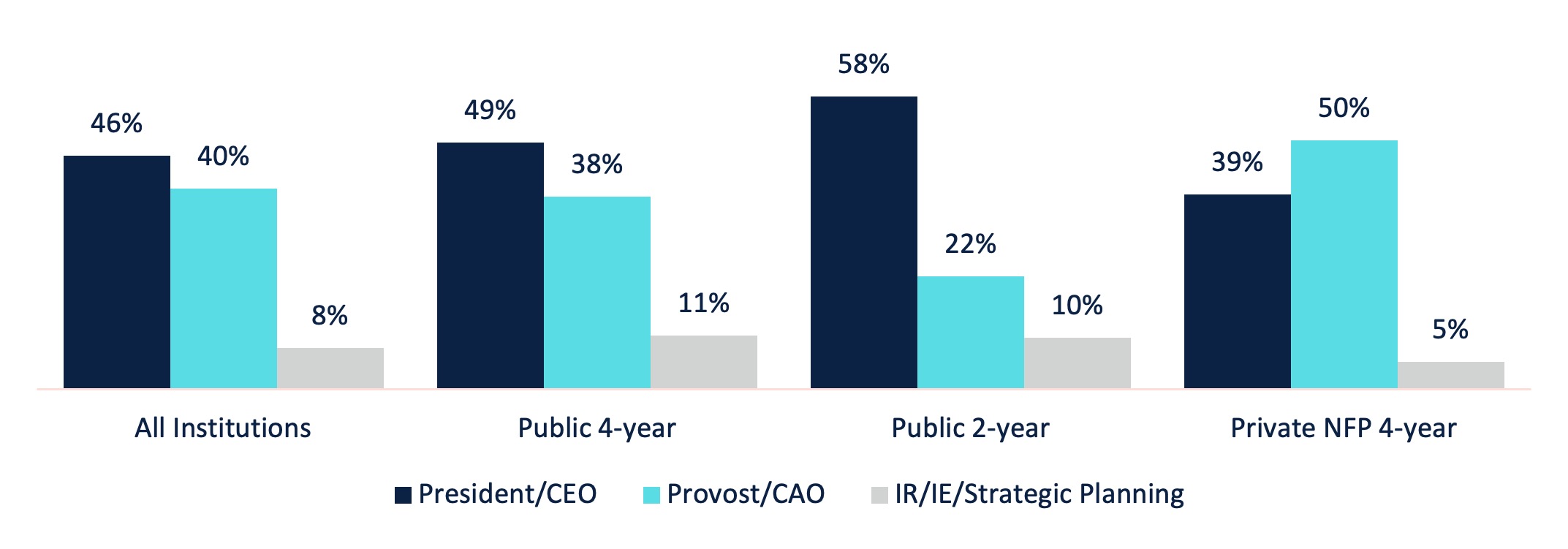
Across sectors, preferences remain consistent, with clear majorities of IR/IE leaders favoring reporting to the President and Provost. Few respondents selected IT, Finance, or Enrollment Management, reinforcing the perception of IR/IE as a strategic rather than operational function (Table 7).
| Role | All Institutions | Public 4-year | Public 2-year | Private NFP 4-year |
|---|---|---|---|---|
| President/CEO | 46% | 49% | 58% | 39% |
| Provost/CAO | 40% | 38% | 22% | 50% |
| IR/IE/Strategic Planning | 8% | 11% | 10% | 5% |
| Administration Services | 0% | 0% | 2% | 0% |
| Finance/Operations/Business | 2% | 1% | 1% | 2% |
| Institutional Advancement/Development or similar office | 0% | 0% | 2% | 0% |
| Enrollment Management/Admissions | 2% | 0% | 1% | 2% |
| Information Technology (IT) | 2% | 1% | 4% | 2% |
Among the 51% of IR/IE offices that are not currently reporting to their preferred division, 70% indicated the President as their ideal reporting line, and another 16% indicated the Provost (Table 8). These findings highlight a persistent gap between existing reporting structures and where IR/IE leaders believe their offices can have the greatest strategic impact.
| Role | All Institutions | Public 4-year | Public 2-year | Private NFP 4-year |
|---|---|---|---|---|
| President/CEO | 70% | 72% | 77% | 65% |
| Provost/CAO | 16% | 15% | 15% | 18% |
| IR/IE/Strategic Planning | 11% | 12% | 8% | 12% |
| Information Technology (IT) | 1% | 1% | 0% | 2% |
| Enrollment Management/Admissions | 1% | 0% | 0% | 2% |
| Finance/Operations/Business | 1% | 0% | 0% | 1% |
Summary
The 2024 AIR National Survey shows that while most IR/IE offices operate as single units reporting to academic leadership, structural variation persists by sector and size. Larger and private institutions are more likely to use multi-unit models, while public 2-year institutions display greater diversity in where IR/IE offices are housed. Over time, more IR/IE offices have aligned under the Provost, yet a growing number now report directly to the President reflecting an ongoing shift toward more strategic roles.
Still, more than half of IR/IE leaders are not reporting where they would prefer, with most desiring a closer connection to presidential leadership. As IR/IE functions become increasingly central to institutional strategy, planning, and student success, institutions may wish to revisit reporting structures to ensure IR/IE offices are positioned for influence and impact.
Methodology
The 2024 AIR National Survey targeted leaders of Institutional Research and Effectiveness (IR/IE) offices at 1,676 U.S. postsecondary, degree-granting institutions across all sectors, control types, and sizes. A total of 633 institutions submitted responses. To ensure comparability and data quality, this report excludes incomplete responses as well as those from for-profit institutions, administrative units, international institutions, private not-for-profit 2-year institutions, and institutions located in U.S. territories due to low response rates in these categories.
The findings presented in this report are based on 552 complete or semi-complete responses from U.S. degree-granting institutions, including:
- 183 public 4-year institutions
- 118 public 2-year institutions
- 251 private not-for-profit 4-year institutions
Where possible, longitudinal comparisons are included. These comparisons draw on data from:
- 253 institutions that responded to both the 2024 and 2021 AIR National Surveys
- 147 institutions that responded to the 2024, 2021, and 2018 AIR National Surveys
Suggested Citation
Jones, D. and Keller, C. (2024). 2024 AIR National Survey: IR/IE Office Organizational Structure [Report]. Association for Institutional Research. www.airweb.org/NationalSurvey.
Long Description
Chart 1. Structure of the IR/IE Data Function
Numerical values presented on the image:
| Structure | All Institutions | Public 4-year | Public 2-year | Private NFP 4-year |
|---|---|---|---|---|
| % of institutions with a single office providing IR/IE work | 82% | 81% | 90% | 79% |
| % of institutions with multiple offices providing IR/IE work | 13% | 11% | 6% | 20% |
| % of institutions with the IR/IE function residing within another unit | 5% | 8% | 4% | 1% |
Chart 2. Top Three Current IR/IE Office Reporting Relationships by Sector
Numerical values presented on the image:
| Role | All Institutions | Public 4-year | Public 2-year | Private NFP 4-year |
|---|---|---|---|---|
| Provost/CAO | 55% | 57% | 32% | 66% |
| President/CEO | 21% | 20% | 29% | 18% |
| IR/IE/Strategic Planning | 7% | 8% | 15% | 3% |
Chart 3. Top Three Ideal IR/IE Office Reporting Relationships by Sector
Numerical values presented on the image:
| Role | All Institutions | Public 4-year | Public 2-year | Private NFP 4-year |
|---|---|---|---|---|
| President/CEO | 46% | 49% | 58% | 39% |
| Provost/CAO | 40% | 38% | 22% | 50% |
| IR/IE/Strategic Planning | 8% | 11% | 10% | 5% |