
2024 AIR National Survey: IR/IE Office Work
This brief is one of a series of reports. Learn more at airweb.org/nationalsurvey.
While the role of Institutional Research and Institutional Effectiveness (IR/IE) in using data and insights to improve institutional performance and student success is widely recognized, the specific activities and priorities of IR/IE offices vary by institutional context. The 2024 AIR National Survey examined these differences, exploring how IR/IE offices allocate their time and effort, which functions they prioritize, and how their responsibilities align with institutional structures and student success initiatives.
The results highlight that IR/IE offices remain essential providers of data, analytics, and insight across higher education institutions. Most continue to focus on compliance reporting and decision support, while a growing number has expanded their roles to encompass institutional effectiveness, assessment, strategic planning, and data literacy.
An institution’s approach to IR/IE office structure plays a key role in shaping this work. Centralized models often align with traditional IR responsibilities, while decentralized models support more distributed analytics needs across academic and administrative units. Regardless of structure, IR/IE offices consistently report high levels of engagement with student success initiatives and a service orientation that supports senior leadership, academic departments, and external stakeholders.
As expectations for data use continue to grow, the results of the survey underscore the importance of recognizing and investing in the full scope of IR/IE work. Whether centralized or distributed, IR-focused or broad, offices that are well-positioned, well-staffed, and well-integrated into institutional decision-making processes will be best equipped to support institutional goals in the years ahead.
Work Output
IR/IE offices devote most of their effort to core data reporting and decision support functions. On average, 61% of work output is focused on compliance reporting, non-compliance reporting, and decision support at the institution and program levels. The remainder of office effort is distributed across functions such as assessment, accreditation, institutional effectiveness, strategic planning, business intelligence, data governance, and data literacy (Chart 1).
Chart 1. Percentage of Office Work Output by Category
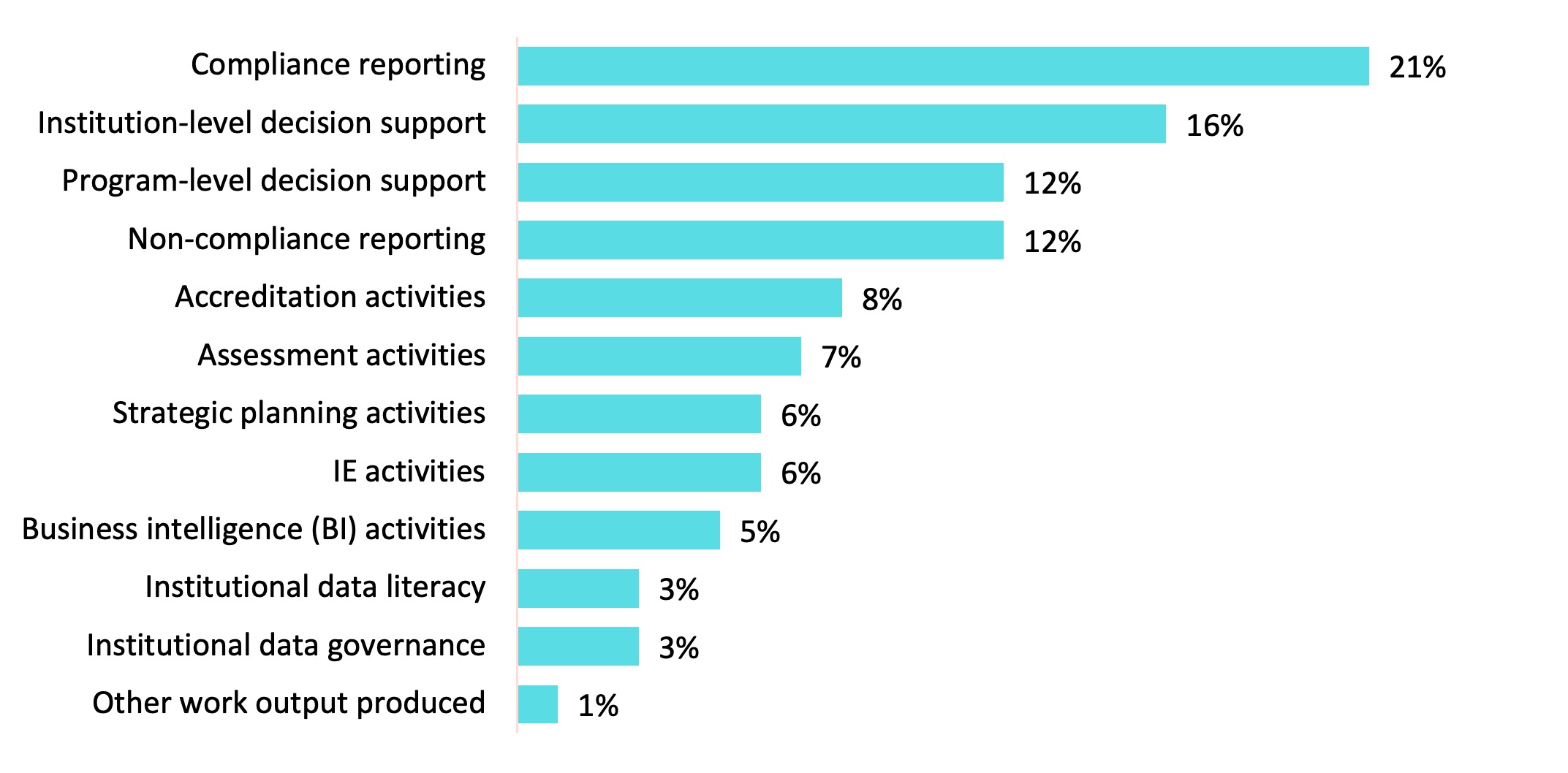
The distribution of work output is consistent across public 4-year, public 2-year, and private not-for-profit 4-year institutions, with minor variations (Table 1). Compliance reporting is the largest single category in all sectors, especially among public 2-year institutions (24%).
| Category | All Institutions | Public 4-year | Public 2-year | Private NFP 4-year |
|---|---|---|---|---|
| Compliance reporting | 21% | 19% | 24% | 21% |
| Institution-level decision support | 16% | 17% | 15% | 16% |
| Non-compliance reporting | 12% | 12% | 10% | 14% |
| Program-level decision support | 12% | 12% | 12% | 11% |
| Accreditation activities | 8% | 6% | 8% | 9% |
| Assessment activities | 7% | 6% | 7% | 7% |
| IE activities | 6% | 6% | 7% | 6% |
| Strategic planning activities | 6% | 6% | 7% | 5% |
| Business intelligence (BI) activities | 5% | 8% | 5% | 4% |
| Institutional data governance | 3% | 3% | 2% | 3% |
| Institutional data literacy | 3% | 3% | 3% | 2% |
| Other work output produced | 1% | 2% | 0% | 2% |
Among IR/IE offices that responded in both 2021 and 2024, the share of work dedicated to compliance reporting increased from 20% to 24%, while other core functions, such as decision support, business intelligence, and institutional effectiveness, remained stable or declined slightly (Table 2). This suggests growing federal/state reporting obligations or increased institutional attention to regulatory compliance.
| Category | 2024 | 2021 |
|---|---|---|
| Compliance reporting | 24% | 20% |
| Decision support | 19% | 19% |
| Non-compliance reporting | 15% | 15% |
| Accreditation activities | 10% | 9% |
| Assessment activities | 9% | 9% |
| Institutional effectiveness activities | 8% | 9% |
| Business intelligence (BI) activities | 7% | 9% |
| Strategic planning activities | 7% | 7% |
| Other work output produced | 2% | 4% |
*Not all work output categories were included in the 2021 survey; only comparable categories are presented.
Classifying IR/IE Offices by Work Output
To better understand patterns in office focus, we applied k-means cluster analysis to group IR/IE offices into two categories, providing a simpler framework for interpreting and applying the results. Overall, 62% of offices were classified as primarily IR-focused in their work, emphasizing compliance reporting, decision support, and business intelligence, while 38% had a broader portfolio that included more institutional effectiveness, assessment, and planning activities (Chart 2). Public 4-year institutions were most likely to have an IR focus (70%), while public 2-year institutions had the highest proportion of broader-scope offices (47%).
Chart 2. Classification of IR/IE Offices Based on Work Focus by Sector

*Compliance and non-compliance reporting, institution and program-level decision support, and BI.
IR-focused offices dedicate 76% of their work to IR activities, with only 17% devoted to IE-related activities (Chart 3). In contrast, offices with broader portfolios divide their time more evenly: 51% to IR-related activities and 41% to IE-related activities. This balance suggests that broader offices often play more integrative roles, supporting both strategic and operational decision making.
Chart 3. Breakdown of Work Output by IR/IE Office Classification
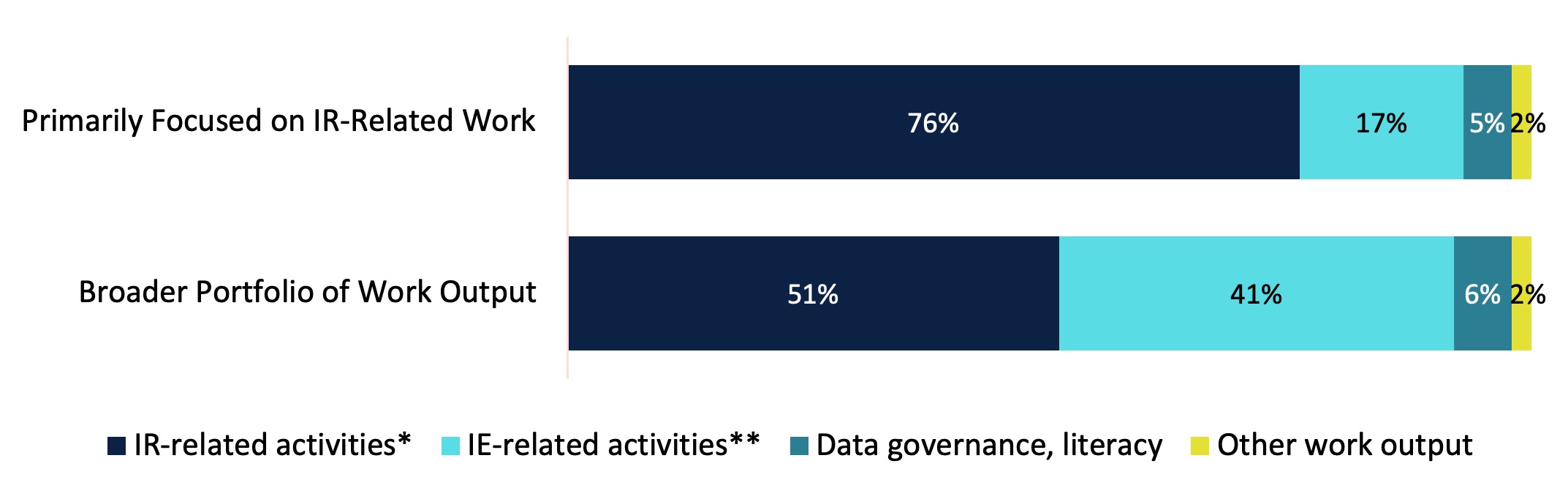
*Compliance and non-compliance reporting, institution and program-level decision support, and BI.
**Institution effectiveness, assessment, accreditation, and strategic planning.
Centralized vs. Distributed Institutional Data Functions
Institutions vary widely in how they organize and manage their data and analytics functions. At some colleges and universities, a centralized data function places primary responsibility for institutional data, reporting, and analytics within a central IR/IE office. In this model, the IR/IE team serves as the main hub for data expertise, coordination, and output. In contrast, a distributed data function involves multiple offices (e.g., IR/IE, enrollment management, student affairs, finance, academic departments) contributing to the institution’s overall data and analytics efforts. Each model presents distinct benefits and challenges related to consistency, collaboration, capacity, and responsiveness.
We asked leaders whether their IR/IE office is responsible for most (≥75%) of the institution’s work in each functional area (Chart 4). 66% of IR/IE offices reported leading compliance reporting, and 57% of IR/IE offices lead institutional-level decision support. In contrast, lower proportions of IR/IE offices reported leading BI (39%), assessment (35%), and strategic planning (29%), indicating that these functions are more often shared across units.
Chart 4. Percent of IR/IE Offices Providing Most* of the Institutional Work
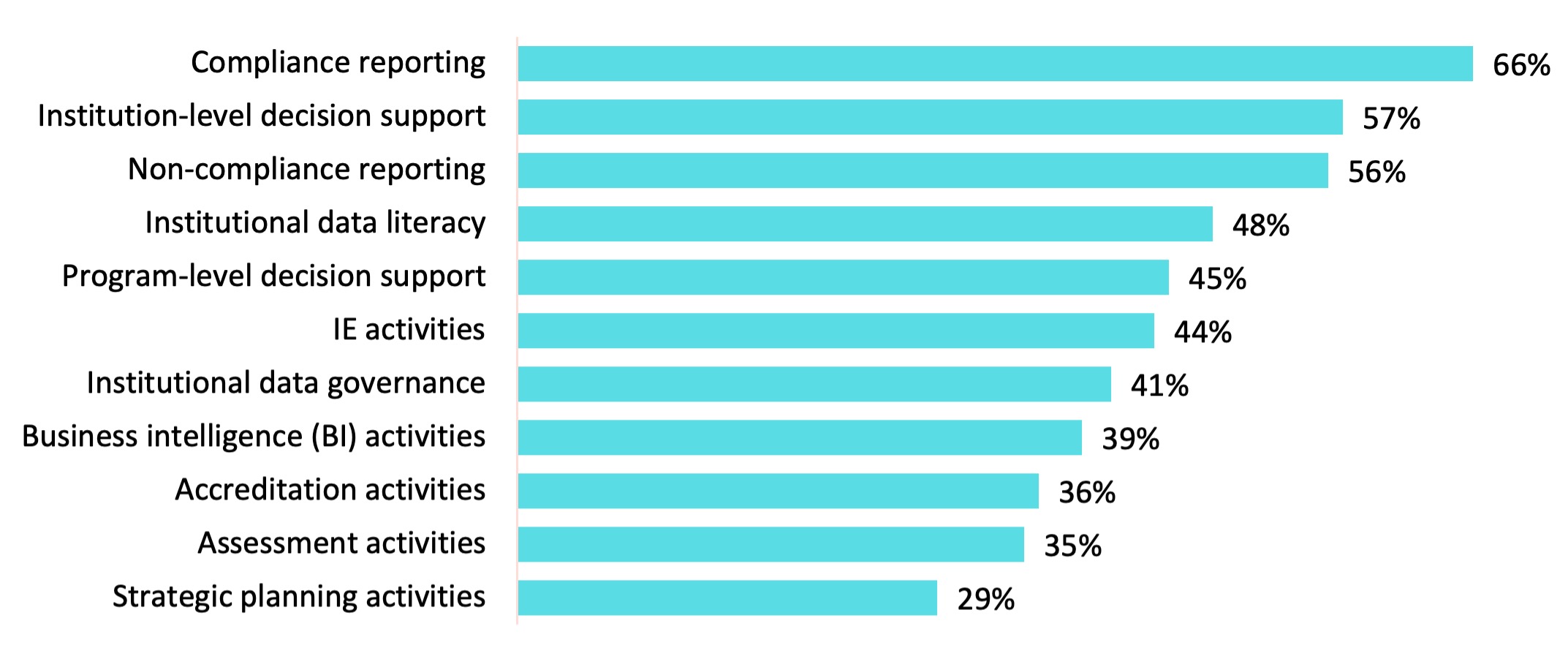
Image Description
*75% or more of institutional work in functional areas is provided by IR/IE Office.
Sector comparisons reveal meaningful differences in who leads what. Private not-for-profit 4-year institutions are most likely to rely on IR/IE for compliance and non-compliance reporting, while public 4-year institutions rely on IR/IE more for institution-level decision support. Public 2-year institutions report lower involvement in assessment and data governance, suggesting these functions may reside in other departments (Table 3).
| Functional Area | All Institutions | Public 4-year | Public 2-year | Private NFP 4-year |
|---|---|---|---|---|
| Compliance reporting | 66% | 59% | 64% | 71% |
| Non-compliance reporting | 56% | 56% | 49% | 63% |
| Institution-level decision support | 57% | 62% | 54% | 53% |
| Program-level decision support | 45% | 47% | 48% | 42% |
| Institutional data governance | 41% | 39% | 33% | 48% |
| Institutional data literacy | 48% | 49% | 48% | 46% |
| Business intelligence (BI) activities | 39% | 41% | 41% | 36% |
| IE activities | 44% | 45% | 47% | 40% |
| Assessment activities | 35% | 39% | 27% | 35% |
| Accreditation activities | 36% | 32% | 38% | 39% |
| Strategic planning activities | 29% | 28% | 31% | 29% |
*75% or more of institutional work in functional areas provided by IR/IE Office.
To assess whether an institution has a centralized or distributed data function, we analyzed IR/IE office involvement across the functional areas listed in Table 3 and established thresholds to classify each institution's structure (Chart 5). We found that 37% of institutions operate with a centralized data function, in which IR/IE leads the institutional work in more than half of the functional areas. 39% are distributed, with IR/IE leading the institutional work in fewer than a third of the functional areas. The remaining 25% showed mixed or unclear patterns, indicating institutional diversity in how institutional data and analytics work are distributed.
Chart 5. Percentage of Institutions with Centralized or Distributed Data Functions

*IR/IE Office conducted most (75% or more) of institutional work in more than six or more functional areas.
**IR/IE Office conducted most of the institutional work in three or fewer functional areas.
IR/IE Office Classification and Institutional Data Functions
In this analysis, we classified IR/IE offices based on their work focus: either IR-focused (emphasizing compliance reporting and decision support) or broader-scope (including more institutional effectiveness, assessment, and planning activities). We also classified institutions by the structure of their data function, identifying them as centralized or distributed based on how much of the institution’s data and analytics work is conducted by the IR/IE office. The question, then, is how these two classifications intersect.
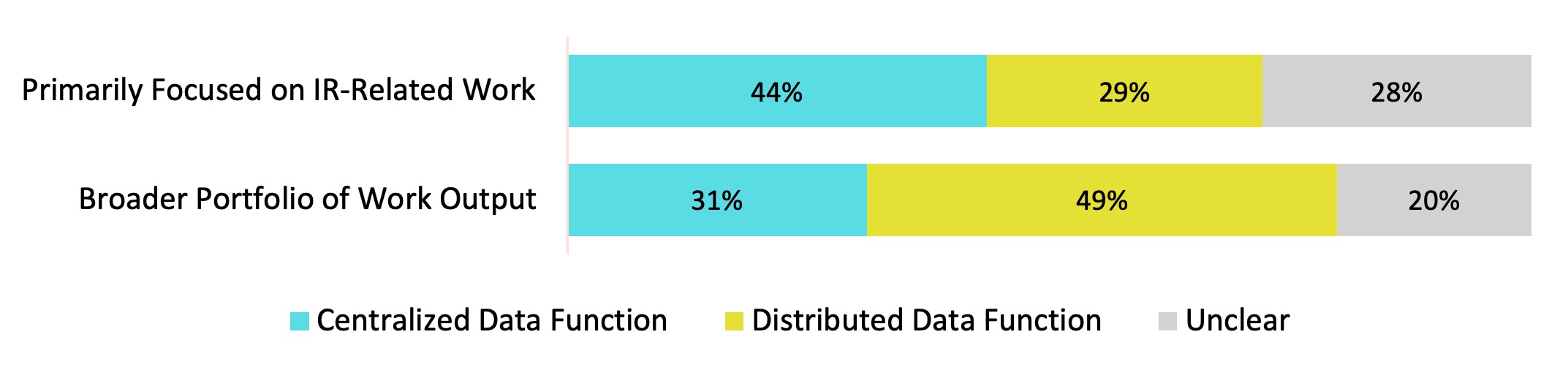
We found that 44% of IR-focused offices were located at institutions with centralized data functions. This pairing (an IR-focused office within a centralized structure) suggests that the institution’s analytics activity is concentrated around traditional IR functions, such as compliance reporting and decision support (Chart 6).
Conversely, 49% of broader-scope offices were located at institutions with distributed data functions. This combination may indicate a more diverse institutional data landscape, where analytics responsibilities are shared across units, and/or a greater institutional demand for advanced decision support capabilities beyond traditional IR functions.
Together, these patterns suggest that the structure of an institution’s data function often reinforces the focus and scope of its IR/IE office, shaping how data are organized, shared, and ultimately used to advance institutional goals, including student success.
Chart 6. Intersection of IR/IE Office Classification and Institutional Data Function
Contributions to Student Success
While most IR/IE offices provide information to support decision making, a key question remains: To what extent is that information meaningfully connected to student success?
To explore this, we asked office leaders to rate the extent to which their offices contribute to institutional student success efforts, using a 5-point Likert scale. As shown in Chart 7, an overwhelming 95% of IR/IE offices reported collaborating with colleagues across their institutions in support of student success initiatives.
Chart 7. Contribution of IR/IE Office to Student Success

Institutions that responded in both 2021 and 2024 showed modest but consistent increases across all student success measures (Table 4).
| Contribution to Student Success | 2024 | 2021 |
|---|---|---|
| Collaborates with colleagues across the institution in support of student success. | 98% | 96% |
| Contributes directly or indirectly to equitable student success. | 87% | 81% |
| Contributes directly or indirectly to overall student success. | 91% | 90% |
Top Stakeholders
Understanding the primary stakeholders served by the IR/IE office offers valuable insight into the office’s focus and impact. In the 2024 AIR National Survey, we asked office leaders to rank the top five stakeholder groups who most frequently use their office’s products (e.g., analytics, reports, dashboards). As shown in Table 5, senior leaders are the most frequent users of IR/IE office products across all sectors. The next three stakeholder groups (external entities, academic departments, and enrollment management units) appear consistently, though their order varies slightly by sector.
| Stakeholders | All Institutions | Public 4-year | Public 2-year | Private NFP 4-year |
|---|---|---|---|---|
| Senior leadership offices | 1 | 1 | 1 | 1 |
| External entities or organizations | 2 | 4 | 2 | 2 |
| Academic colleges/departments | 3 | 2 | 3 | 3 |
| Enrollment management units | 4 | 3 | 4 | 4 |
These findings highlight the dual technical and relational role that IR/IE offices play in advancing effective data use across institutions.
| Stakeholders | All Institutions | Public 4-year | Public 2-year | Private NFP 4-year |
|---|---|---|---|---|
| Academic colleges/departments | 1 | 1 | 1 | 1 |
| Senior leadership offices | 2 | 2 | 2 | 2 |
| Enrollment management units | 3 | 3 | 4 | 3 |
| Academic support units | 4 | 4 | 3 | 4 |
Summary
The 2024 AIR National Survey affirms that IR/IE offices remain essential partners in providing the data, analytics, and insights that support improved decision making. As expectations for data use and compliance reporting continue to expand, offices that are well positioned within their institutions, and that balance technical expertise with collaboration, will be best equipped to advance student success and organizational effectiveness.
Methodology
The 2024 AIR National Survey targeted leaders of Institutional Research and Effectiveness (IR/IE) offices at 1,676 U.S. postsecondary, degree-granting institutions across all sectors, control types, and sizes. A total of 633 institutions submitted responses. To ensure comparability and data quality, this report excludes incomplete responses as well as those from for-profit institutions, administrative units, international institutions, private not-for-profit 2-year institutions, and institutions located in U.S. territories due to low response rates in these categories.
The findings presented in this report are based on 552 complete or semi-complete responses from U.S. degree-granting institutions, including:
- 183 public 4-year institutions
- 118 public 2-year institutions
- 251 private not-for-profit 4-year institutions
Where possible, longitudinal comparisons are included. These comparisons draw on data from:
- 253 institutions that responded to both the 2024 and 2021 AIR National Surveys
- 147 institutions that responded to the 2024, 2021, and 2018 AIR National Surveys
Suggested Citation Jones, D. and Keller, C. (2024). 2024 AIR National Survey: IR/IE Office Work [Report]. Association for Institutional Research. www.airweb.org/NationalSurvey.
Long Description
Chart 1. Percentage of Office Work Output by Category
Numerical values presented on the image:
| Category | All Institutions |
|---|---|
| Compliance reporting | 21% |
| Institution-level decision support | 16% |
| Non-compliance reporting | 12% |
| Program-level decision support | 12% |
| Accreditation activities | 8% |
| Assessment activities | 7% |
| IE activities | 6% |
| Strategic planning activities | 6% |
| Business intelligence (BI) activities | 5% |
| Institutional data governance | 3% |
| Institutional data literacy | 3% |
| Other work output produced | 1% |
Chart 2. Classification of IR/IE Offices Based on Work Focus by Sector
Numerical values presented on the image:
| Focus | All Institutions | Public 4-year | Public 2-year | Private NFP 4-year |
|---|---|---|---|---|
| Primarily focused on IR-Related Work* | 62% | 70% | 53% | 60% |
| Broader Portfolio of Work Output | 38% | 30% | 47% | 40% |
Chart 3. Breakdown of Work Output by IR/IE Office Classification
Numerical values presented on the image:
| Work Output | Broader Portfolio of Work Output | Primarily Focused on IR-Related Work |
|---|---|---|
| IR-related activities* | 51% | 76% |
| IE-related activities** | 41% | 17% |
| Data governance, literacy | 6% | 5% |
| Other work output | 2% | 2% |
Chart 4. % of IR/IE Offices Providing Most* of the Institutional Work
Numerical values presented on the image:
| Office | All Institutions |
|---|---|
| Compliance reporting | 66% |
| Institution-level decision support | 57% |
| Non-compliance reporting | 56% |
| Institutional data literacy | 48% |
| Program-level decision support | 45% |
| IE activities | 44% |
| Institutional data governance | 41% |
| Business intelligence (BI) activities | 39% |
| Accreditation activities | 36% |
| Assessment activities | 35% |
| Strategic planning activities | 29% |
Chart 5. Percentage of Institutions with Centralized or Distributed Data Functions
Numerical values presented on the image:
| Function | All Institutions |
|---|---|
| Centralized Data Function* | 37% |
| Distributed Data Function** | 39% |
| Unclear | 25% |
Chart 6. Intersection of IR/IE Office Classification and Institutional Data Function
Numerical values presented on the image:
| Function | Broader Portfolio of Work Output | Primarily Focused on IR-Related Work |
|---|---|---|
| Centralized Data Function | 31% | 44% |
| Distributed Data Function | 49% | 29% |
| Unclear | 20% | 28% |
Chart 7. Contribution of IR/IE Office to Student SuccessUsing IR Products or Coaching Services: % High or Very High Utilization
Numerical values presented on the image:
| Contribution type | Strongly/moderately disagree | Neutral | Strongly/moderately agree |
|---|---|---|---|
| Contributes directly or indirectly to equitable student success. | 3% | 11% | 86% |
| Contributes directly or indirectly to overall student success. | 3% | 6% | 91% |
| Collaborates with colleagues across the institution in support of student success. | 2% | 3% | 95% |