
2024 AIR National Survey:
IR/IE Office Leadership and Management
This brief is one of a series of reports. Learn more at airweb.org/nationalsurvey.
Institutional Research and Institutional Effectiveness (IR/IE) office leaders are central to advancing data-informed decision making that supports institutional and student success. Beyond managing IR/IE functions, they serve as strategic advisors, mentors, and technical experts that connect data and decision makers. Drawing on findings from the 2024 AIR National Survey, this brief explores the professional backgrounds resources and executive relationships of IR/IE leaders to better understand how these factors both influence and reflect their institutions’ data cultures.
Demographic Profile
IR/IE office leaders are predominantly between 50 and 59 years old (40%), identify as women (63%), and identify as white (82%). Another 14% are 60 years old or older, underscoring the profession's aging demographic (Chart 1).
Chart 1. IR/IE Office Leader Demographic Profile
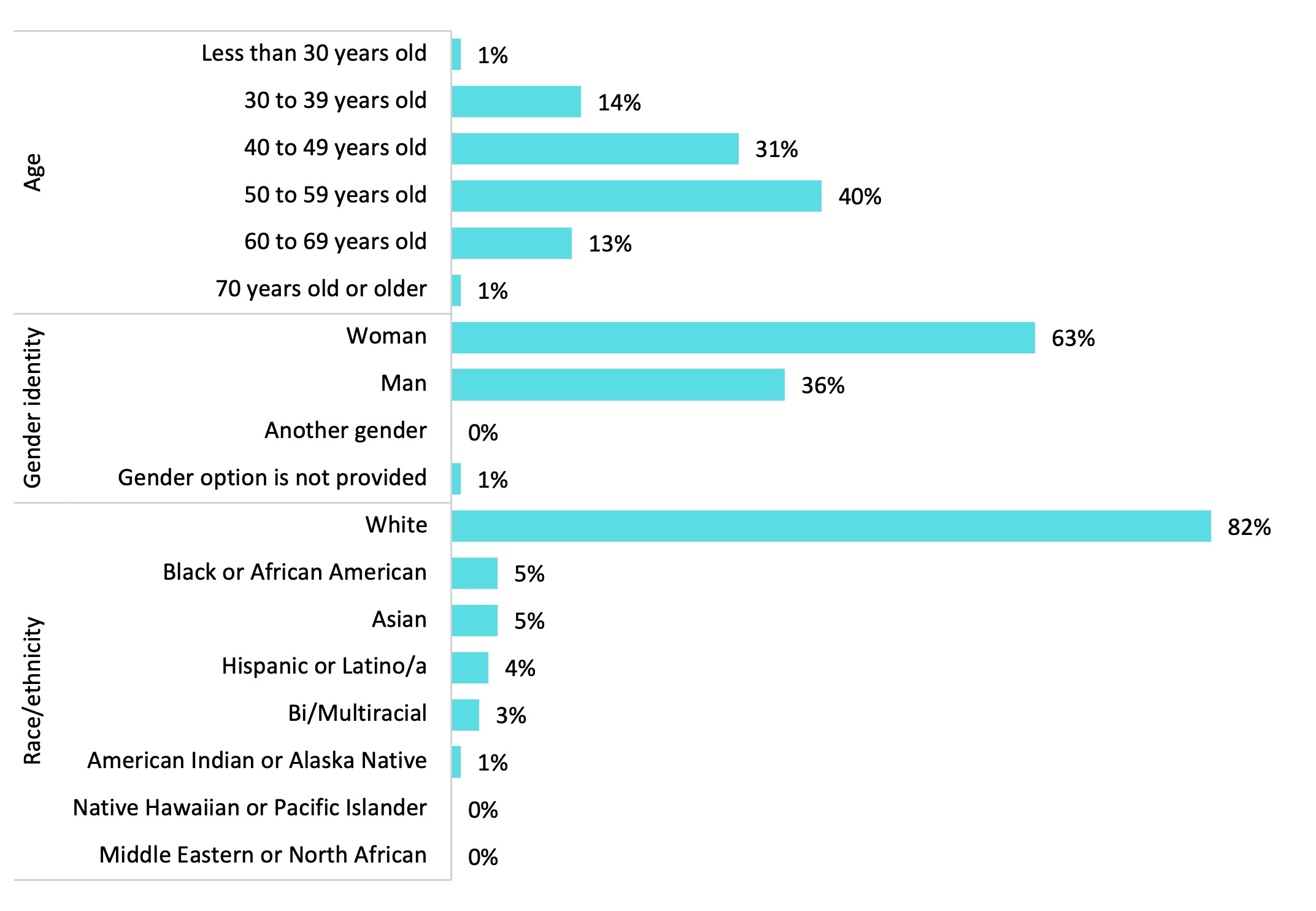
By sector, public 2-year institutions report the highest proportion of female leaders (76%), while private not-for-profit 4-year institutions have the highest share of male leaders (41%). Racial and ethnic diversity remains limited across all sectors, though public 4-year institutions show slightly greater representation of leaders of color (Table 1).
| Demographic | All Institutions | Public 4-year | Public 2-year | Private NFP 4-year |
|---|---|---|---|---|
| Age | ||||
| Less than 30 years old | 1% | 1% | 1% | 2% |
| 30 to 39 years old | 14% | 12% | 13% | 16% |
| 40 to 49 years old | 31% | 34% | 28% | 30% |
| 50 to 59 years old | 40% | 39% | 44% | 38% |
| 60 to 69 years old | 13% | 13% | 13% | 13% |
| 70 years old or older | 1% | 1% | 1% | 1% |
| Gender identity | ||||
| Woman | 63% | 62% | 76% | 57% |
| Man | 36% | 36% | 24% | 41% |
| Another gender | 0% | 0% | 0% | 0% |
| Gender option is not provided | 1% | 2% | 0% | 2% |
| Race/ethnicity | ||||
| American Indian or Alaska Native | 1% | 1% | 1% | 0% |
| Asian | 5% | 7% | 3% | 4% |
| Bi/Multiracial | 3% | 2% | 3% | 4% |
| Black or African American | 5% | 6% | 6% | 4% |
| Hispanic or Latino/a | 4% | 7% | 2% | 3% |
| Middle Eastern or North African | 0% | 0% | 0% | 0% |
| Native Hawaiian or Pacific Islander | 0% | 0% | 0% | 0% |
| White | 82% | 77% | 85% | 85% |
Highest Degree Earned
Across all institutions, 94% of IR/IE office leaders hold postgraduate degrees, evenly divided between master’s and doctoral degrees (Table 2). Leaders at private not-for-profit 4-year institutions are most likely to hold a doctorate (52%), while those at public 2-year institutions are more likely to have a master’s degree (58%).
| Degree | All Institutions | Public 4-year | Public 2-year | Private NFP 4-year |
|---|---|---|---|---|
| Baccalaureate degree or lower | 6% | 4% | 6% | 7% |
| Master’s degree/Specialist | 47% | 50% | 58% | 41% |
| Doctoral degree including professional practice doctorates | 47% | 46% | 36% | 52% |
Among IR/IE offices who responded to the 2018, 2021, and 2024 surveys, the proportion of leaders holding graduate-level degrees rose slightly, suggesting a modest trend towards more advanced credentials (Table 3).
| Degree | 2024 | 2021 | 2018 |
|---|---|---|---|
| Baccalaureate degree or lower | 4% | 5% | 8% |
| Master’s degree/Specialist | 48% | 46% | 45% |
| Doctoral degree including professional practice doctorates | 48% | 49% | 47% |
Relevant Work Experience
Because there is no dedicated degree pathway for IR/IE professionals, office leaders typically bring transferable experience from related roles across higher education. On average, IR/IE leaders have spent over 20 years in higher education, nearly 14 years in IR/IE, and nearly 12 years at their current institution (Table 4). Leaders at public 4-year institutions report slightly more experience in both higher education and IR/IE than their peers in other sectors.
| Experience | All Institutions | Public 4-year | Public 2-year | Private NFP 4-year |
|---|---|---|---|---|
| # Years working in higher education | 20.1 | 21.2 | 19.4 | 19.6 |
| # Years working in IR/IE regardless of the institution | 13.8 | 15.7 | 13.5 | 12.7 |
| # Years working at current institution (current or other position) | 11.7 | 12.1 | 11.4 | 11.5 |
| # Years leading the IR/IE office at current institution | 6.7 | 6.4 | 7.4 | 6.6 |
Results from 2024 show a steady increase in experience levels since 2018, with leaders averaging two additional years in higher education, 1.8 years in IR/IE, and modest increases in years of service at their current institution and in leadership roles (Table 5). Together, these findings point to a maturing profession with deepening institutional knowledge.
| Experience | 2024 | 2021 | 2018 | Difference: 2024 vs. 2018 |
|---|---|---|---|---|
| # Years working in higher education | 20.9 | 20.2 | 18.9 | 2.0 |
| # Years working in IR/IE regardless of the institution | 14.2 | 13.9 | 12.4 | 1.8 |
| # Years working at current institution (current or other position) | 12.4 | 12.5 | 11.3 | 1.1 |
| # Years leading the IR/IE office at current institution | 7.5 | 7.8 | 6.8 | 0.8 |
Office Resources
We asked office leaders to assess the adequacy of their office resources (Chart 2). Most are satisfied with their software and hardware (77%) and office space (76%), yet only 57% agree that their office is adequately funded. This indicates that while technical and physical infrastructure are generally sufficient, financial resources remain a key concern.
Chart 2. Assessment of Office Resources
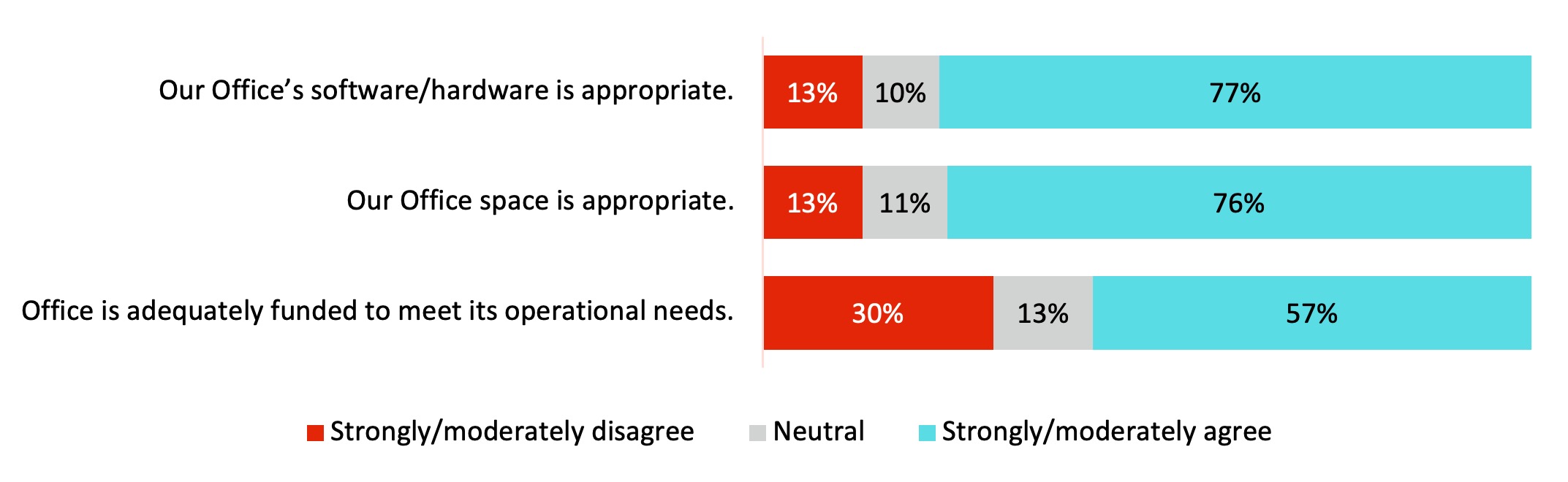
Funding adequacy varies by sector: public 2-year leaders are most likely to agree their office is adequately funded . Satisfaction with software, hardware, and space is high across all sectors, with little variation.
| Assessment | All Institutions | Public 4-year | Public 2-year | Private NFP 4-year |
|---|---|---|---|---|
| Office’s software/hardware is appropriate. | 77% | 79% | 79% | 74% |
| Office space is appropriate. | 76% | 73% | 75% | 77% |
| Office is adequately funded to meet its operational needs. | 57% | 58% | 62% | 54% |
*Survey questions used a 5-point Likert scale: strongly disagree, moderately disagree, neutral, moderately agree, and strongly agree. The results presented here combine the responses for moderately agree and strongly agree.
From 2018 to 2024, satisfaction with software and hardware rose 7-percentage points, and satisfaction with office space increased 4-percentage points (Table 7). These steady gains suggest an incremental improvement in operational infrastructure.
| Assessment | 2024 | 2021 | 2018 |
| Our Office’s software/hardware is appropriate. | 81% | 75% | 74% |
| Our Office space is appropriate. | 76% | 74% | 72% |
*Survey questions used a 5-point Likert scale: strongly disagree, moderately disagree, neutral, moderately agree, and strongly agree. The results presented here combine the responses for moderately agree and strongly agree.
Office Recruitment and Retainment
Most leaders feel confident in their ability to retain talented staff (62%), though fewer are confident in recruiting talented staff, and still fewer in recruiting or retaining a diverse staff (Table 10). Public 4-year institutions report the highest overall confidence in recruitment and retention, particularly regarding diversity.
| Ability | All Institutions | Public 4-year | Public 2-year | Private NFP 4-year |
|---|---|---|---|---|
| Office can retain talented staff. | 62% | 69% | 64% | 56% |
| Office can recruit talented staff. | 55% | 62% | 52% | 51% |
| Office can recruit a diverse staff. | 50% | 58% | 50% | 45% |
| Office can retain a diverse staff. | 49% | 59% | 48% | 41% |
*Survey questions used a 5-point Likert scale: strongly disagree, moderately disagree, neutral, moderately agree, and strongly agree. The results presented here combine the responses for moderately agree and strongly agree.
Since 2018, IR/IE leaders’ confidence has declined both in their ability to recruit and retain talented staff (Table 9). Confidence in retention dropped 13 percentage points, and recruitment dropped 7 percentage points. These patterns suggest increasing challenges in attracting and retaining skilled talent which is potentially linked to resource constraints or growing competition for qualified professionals.
| Ability | 2024 | 2021 | 2018 |
|---|---|---|---|
| Office can retain talented staff. | 60% | 67% | 73% |
| Office can recruit talented staff. | 52% | 54% | 59% |
| Office can recruit a diverse staff. | 44% | 43% | N/A |
| Office can retain a diverse staff. | 42% | 45% | N/A |
*Survey questions used a 5-point Likert scale: strongly disagree, moderately disagree, neutral, moderately agree, and strongly agree. The results presented here combine the responses for moderately agree and strongly agree. N/A: Question was not included in the 2018 survey.
Job Functions
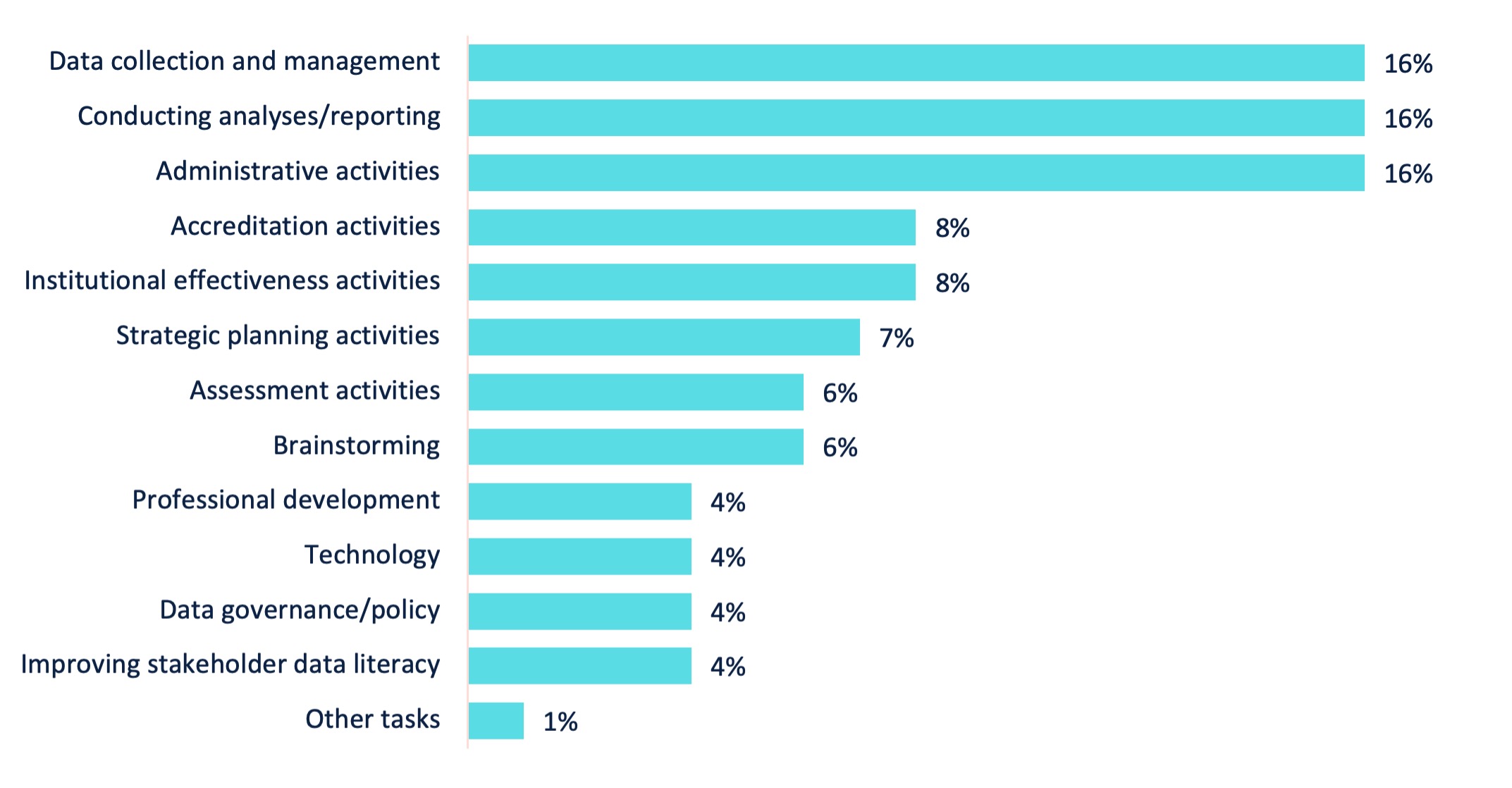
IR/IE office leaders were asked to estimate how their time was distributed across primary job functions. Nearly half of their time (48%) is spent on three functions: data collection and management, analyses and reporting, and administrative duties (Chart 3). There were little differences by sector.
Chart 3. Percentage of IR/IE Office Leader Time Spent by Job Function
Participation with Executive Cabinets
IR/IE office leaders were asked about their participation in their institutions’ executive cabinets. Only 16% of IR/IE leaders serve as members of the presidential cabinet, while 38% are members of the provost cabinet. An additional 35% attend presidential cabinet meetings as needed, and 29% do the same for the provost’s cabinet. These patterns suggest that IR/IE leaders have more consistent access to academic leadership than executive leadership.
Chart 4. Office Leader's Relationship with Executive Cabinets
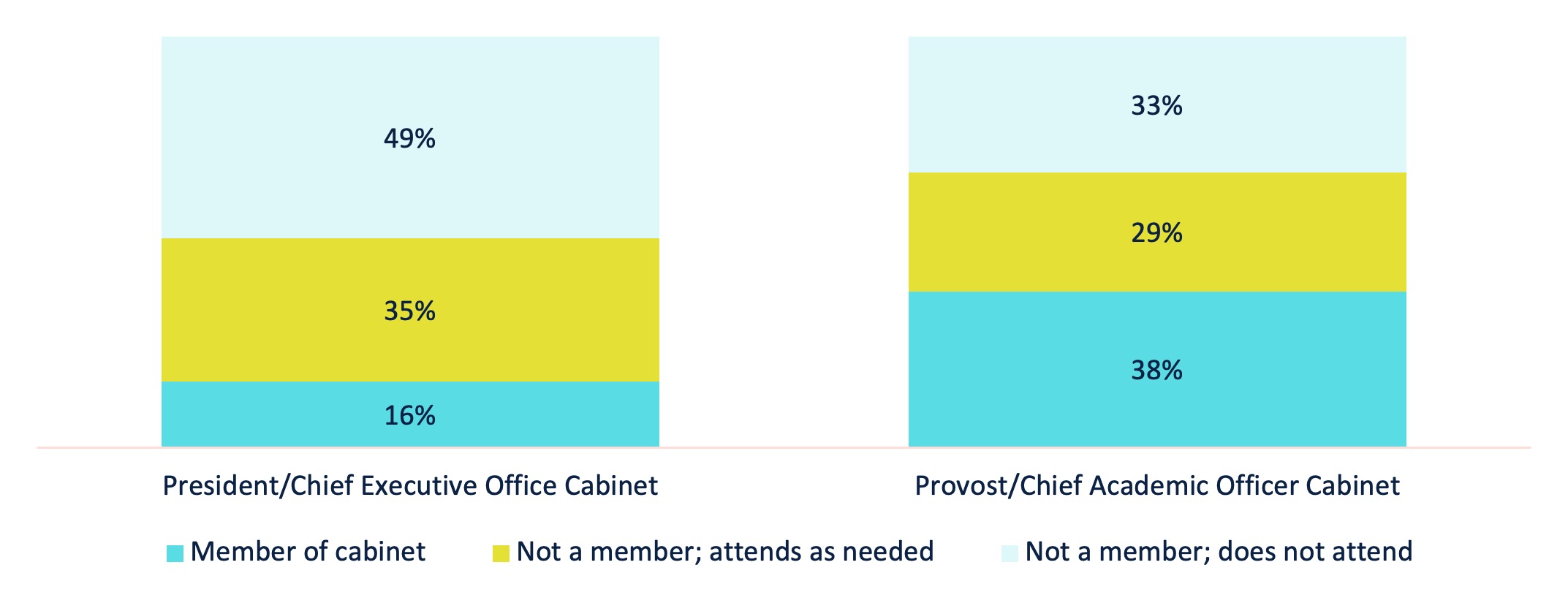
Cabinet participation varies by sector (Table 13). IR/IE leaders at public 2-year institutions are most likely to serve on the presidential cabinet (29%), while those at private not-for-profit institutions are most likely to serve on the provost cabinet (44%). Attendance "as needed" remains common across all sectors, though many leaders lack consistent participation in cabinet-level discussions.
| Participation | All Institutions | Public 4-year | Public 2-year | Private NFP 4-year |
|---|---|---|---|---|
| President/CEO Cabinet | ||||
| Member of cabinet | 16% | 14% | 29% | 11% |
| Not a member but attends meetings as needed | 35% | 40% | 35% | 32% |
| Not a member and does not attend meetings | 49% | 46% | 36% | 57% |
| Provost/CAO Cabinet | ||||
| Member of cabinet | 38% | 34% | 27% | 44% |
| Not a member but attends meetings as needed | 29% | 33% | 43% | 21% |
| Not a member and does not attend meetings | 33% | 33% | 30% | 35% |
Between 2018 and 2024, IR/IE leaders became slightly more likely to serve on provost cabinets (increasing 4 percentage points), but less likely to attend presidential cabinet meetings as needed (declining 8 percentage points). Notably, more leaders now report having no access to the president’s cabinet at all, an increase of 10 percentage points (Table 14).
The decline in presidential cabinet access, paired with a rising percentage of IR/IE leaders reporting no access at all, points to a growing gap in executive-level engagement for IR/IE leaders. This is especially notable when considered alongside findings from the 2024 AIR National Survey: IR/IE Office Organizational Structure, where 46% of office leaders identified the President/CEO as their ideal reporting line, and 70% of those not currently reporting to their preferred division said they would ideally report to the President. Together, these findings suggest a disconnect between how institutions position IR/IE offices and how leaders themselves believe they can be most effective.
| Participation | 2024 | 2021 | 2018 |
|---|---|---|---|
| President/CEO Cabinet | |||
| Member of cabinet | 10% | 10% | 12% |
| Not a member; attends as needed | 33% | 38% | 41% |
| Not a member; does not attend | 57% | 52% | 47% |
| Provost/CAO Cabinet | |||
| Member of cabinet | 37% | 30% | 33% |
| Not a member; attends as needed | 23% | 36% | 39% |
| Not a member; does not attend | 40% | 34% | 28% |
Chief Data Officer
The survey found that 40% of institutions have a designated or de facto Chief Data Officer (CDO), with 21% reporting a named CDO and another 19% indicating a de facto CDO, where someone informally serves in the role (Table 15). This varies slightly by sector: public 4-year institutions are the most likely to have a named CDO, while private not-for-profit 4-year institutions are least likely. However, 60% of institutions report having no CDO at all, suggesting that while the role is gaining traction, it is not yet common across institutions.
| Chief Data Officer | All Institutions | Public 4-year | Public 2-year | Private NFP 4-year |
|---|---|---|---|---|
| Institution has a named CDO | 21% | 24% | 20% | 18% |
| Institution has a de facto CDO | 19% | 21% | 20% | 16% |
| Institution does not have CDO position | 60% | 55% | 60% | 66% |
Among institutions that have a CDO or de facto CDO, nearly two-thirds assign that role to the IR/IE leader (Table 16). Specifically, 19% serve as the official CDO and 45% as the de facto CDO, while in 36% of cases, someone outside the IR/IE office holds that position. The connection is strongest in public 2-year institutions, where 79% of CDO roles are filled by the IR/IE leader, suggesting that at smaller institutions, the IR/IE leader is often the primary data strategist.
| Relationship | All Institutions | Public 4-year | Public 2-year | Private NFP 4-year |
|---|---|---|---|---|
| IR/IE Office Leader is the CDO | 19% | 22% | 29% | 11% |
| IR/IE Officer Leader is the de facto CDO | 45% | 44% | 50% | 44% |
| Another employee is the CDO/de facto CDO | 36% | 35% | 21% | 45% |
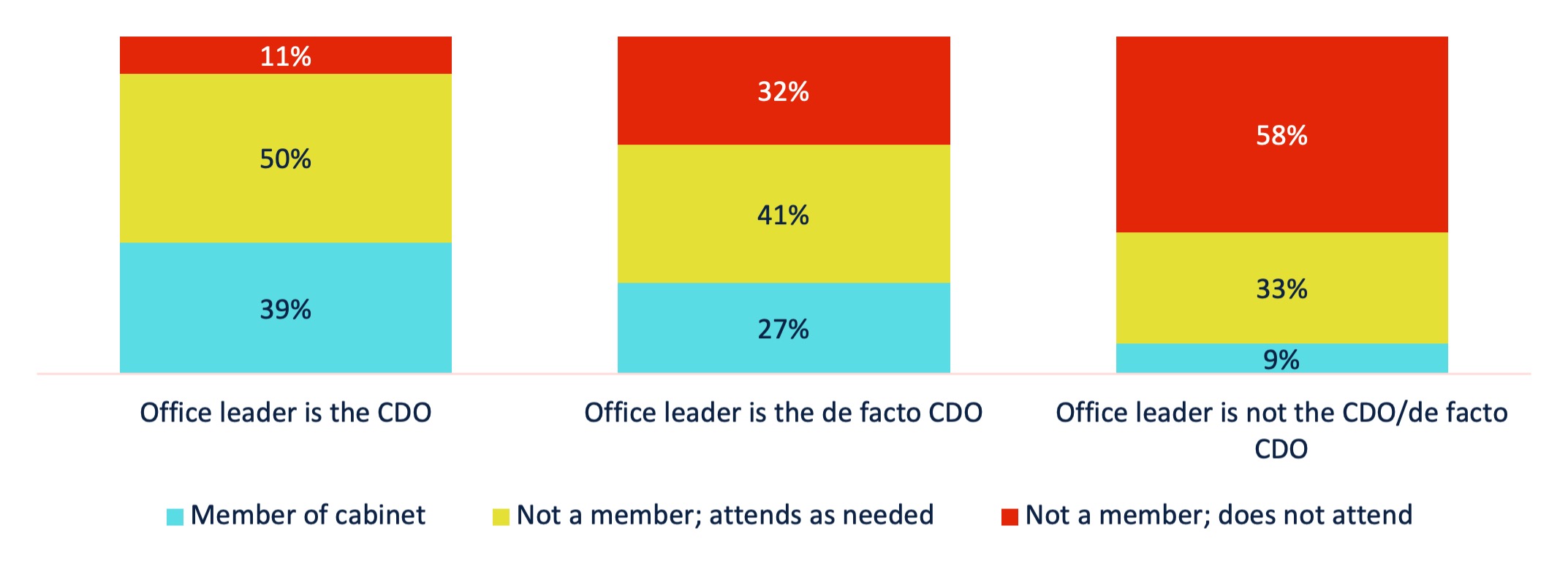
The data show a clear relationship between CDO status and access to executive leadership. Among IR/IE leaders who also serve as the official CDO, 39% are members of the presidential cabinet, compared to 27% of de facto CDOs and 9% of leaders not affiliated with the CDO role (Chart 2). This suggests that formal designation as CDO may provide greater institutional visibility and strategic influence than informal or undefined data leadership roles.
Chart 5. Participation between IR/IE Office Leaders, CDO Status, and President/CEO Cabinet
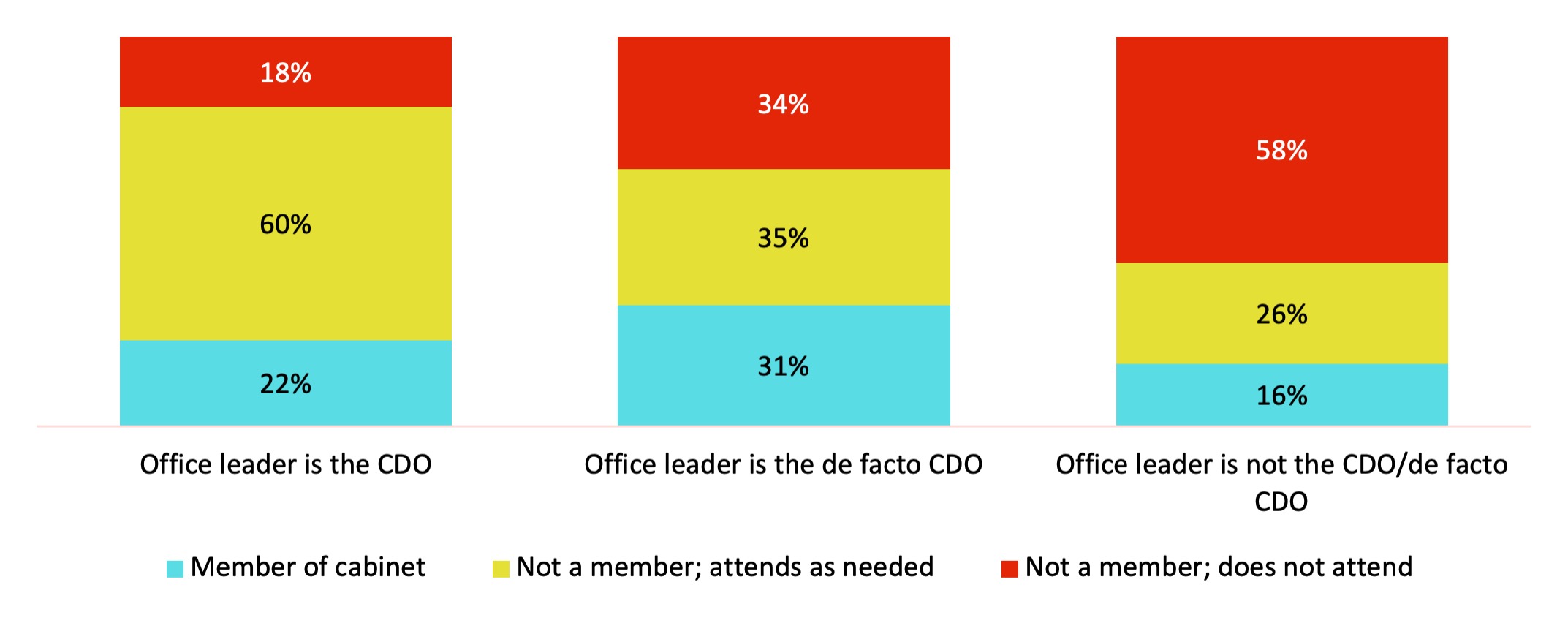
A different pattern emerges at the provost level. Leaders who are de facto CDOs are the most likely to serve on the provost’s cabinet (31%), compared to 22% of leaders who are official CDOs and 16% of those not involved in the CDO role (Chart 6). Leaders who are not serving in any CDO capacity are least likely to participate in provost cabinet discussions, with 58% reporting no access.
Chart 6. Participation between IR/IE Office Leaders, CDO Status, and Provost/CAO Cabinet
Summary
The 2024 AIR National Survey offers a detailed portrait of IR/IE office leaders as experienced, highly educated professionals advancing data-informed decision making across higher education. While most leaders report satisfaction with their office infrastructure and professional preparation, they continue to face challenges in staffing, recruitment, compensation, and executive access. Notably, between 2018 and 2024, presidential cabinet participation declined, and a growing share of IR/IE leaders report no access at all. This is particularly striking given that 46% identify the president as their ideal reporting line.
Emerging data leadership roles, especially Chief Data Officers (CDOs), may be helping to fill this gap. Although only 21% of institutions report a named CDO, another 19% have de facto equivalents, typically held by the IR/IE leader. These dual-role leaders tend to have greater access to presidential and provost-level cabinets, suggesting that formal recognition of data leadership may enhance strategic influence. Yet, 60% of institutions report no CDO at all, indicating that the role development is uneven across higher education.
As institutions face increasing expectations for analytics, planning, and evidence-based strategy, it will be increasingly important to clarify the positioning of IR/IE and CDO functions, strengthen executive access, and invest in the professional development and recognition of data leaders. The future of data-informed leadership may depend not only on expanding capacity, but on redefining roles that ensure IR/IE leaders have a seat at the strategic table.
Methodology
The 2024 AIR National Survey targeted leaders of Institutional Research and Effectiveness (IR/IE) offices at 1,676 U.S. postsecondary, degree-granting institutions across all sectors, control types, and sizes. A total of 633 institutions submitted responses. To ensure comparability and data quality, this report excludes incomplete responses as well as those from for-profit institutions, administrative units, international institutions, private not-for-profit 2-year institutions, and institutions located in U.S. territories due to low response rates in these categories.
The findings presented in this report are based on 552 complete or semi-complete responses from U.S. degree-granting institutions, including:
- 183 public 4-year institutions
- 118 public 2-year institutions
- 251 private not-for-profit 4-year institutions
Where possible, longitudinal comparisons are included. These comparisons draw on data from:
- 253 institutions that responded to both the 2024 and 2021 AIR National Surveys
- 147 institutions that responded to the 2024, 2021, and 2018 AIR National Surveys
Suggested Citation
Jones, D. and Keller, C. (2024). 2024 AIR National Survey: IR/IE Office Leadership and Management [Report]. Association for Institutional Research. www.airweb.org/NationalSurvey.
Long Description
Chart 1. IR/IE Office Leader Demographic Profile
Numerical values presented on the image:
| Age | Percentage |
|---|---|
| Less than 30 years old | 1% |
| 30 to 39 years old | 14% |
| 40 to 49 years old | 31% |
| 50 to 59 years old | 40% |
| 60 to 69 years old | 13% |
| 70 years old or older | 1% |
| Gender identity | Percentage |
|---|---|
| Woman | 63% |
| Man | 36% |
| Another gender | 0% |
| Gender option is not provided | 1% |
| Race/ethnicity | Percentage |
|---|---|
| White | 82% |
| Black or African American | 5% |
| Asian | 5% |
| Hispanic or Latino/a | 4% |
| Bi/Multiracial | 3% |
| American Indian or Alaska Native | 1% |
| Native Hawaiian or Pacific Islander | 0% |
| Middle Eastern or North African | 0% |
Chart 2. Assessment of Office Resources
Numerical values presented on the image:
| Assessment | Strongly/ moderately disagree | Neutral | Strongly/ moderately agree |
|---|---|---|---|
| Office is adequately funded to meet its operational needs. | 30% | 13% | 57% |
| Our Office space is appropriate. | 13% | 11% | 76% |
| Our Office’s software/hardware is appropriate. | 13% | 10% | 77% |
Chart 3. Percentage of IR/IE Office Leader Time Spent by Job Function
Numerical values presented on the image:
| Function | Percentage of Time |
|---|---|
| Administrative activities | 16% |
| Conducting analyses/reporting | 16% |
| Data collection and management | 16% |
| Accreditation activities | 8% |
| Institutional effectiveness activities | 8% |
| Strategic planning activities | 7% |
| Assessment activities | 6% |
| Brainstorming | 6% |
| Data governance/policy | 4% |
| Improving stakeholder data literacy | 4% |
| Professional development | 4% |
| Technology | 4% |
| Other tasks | 1% |
Chart 4. Office Leader's Relationship with Executive Cabinets
Numerical values presented on the image:
| Relationship | President/Chief Executive Office Cabinet | Provost/Chief Academic Officer Cabinet |
|---|---|---|
| Member of cabinet | 16% | 38% |
| Not a member; attends as needed | 35% | 29% |
| Not a member; does not attend | 49% | 33% |
Chart 5. Participation between IR/IE Office Leaders, CDO Status,
and President/CEO Cabinet
Numerical values presented on the image:
| Relationship | Office leader is the CDO | Office leader is the de facto CDO | Office leader is not the CDO/de facto CDO |
|---|---|---|---|
| Member of cabinet | 39% | 27% | 9% |
| Not a member; attends as needed | 50% | 41% | 33% |
| Not a member; does not attend | 11% | 32% | 58% |
Chart 6. Participation between IR/IE Office Leaders, CDO Status,
and Provost/CAO Cabinet
Numerical values presented on the image:
| Relationship | Office leader is the CDO | Office leader is the de facto CDO | Office leader is not the CDO/de facto CDO |
|---|---|---|---|
| Member of cabinet | 22% | 31% | 16% |
| Not a member; attends as needed | 60% | 35% | 26% |
| Not a member; does not attend | 18% | 34% | 58% |